Step Up and Tri – September 2011

Hello everyone!

Welcome to September’s newsletter/blog. I hope you all have had a great August and that training is going well. This month I am going to talk about an issue that comes up in every athlete’s life: pace vs. effort, and why it is so important to understand the difference.

Probably one of the toughest issues for athletes is learning how to pace themselves. To pace yourself does not necessarily mean you actually have to hit a certain absolute pace, but rather that you are parceling out your effort by monitoring your level of exertion so that you can finish the workout or race strong.

I think that many athletes believe that pace and effort are synonymous and interchangeable, but they are not. The main difference is that pace is very contingent upon extraneous variables: wind, hills, heat, and training status (how tired the athlete is), but effort is more of a subjective measure that allows for some variation and can absorb those extraneous variables. For instance, I went out for a ride last Sunday and headed out with the wind up to Palm Beach. I was feeling good! I had a tailwind and was zipping along in Z3 power and HR at 25mph. Of course, at some point unfortunately I had to turn around and ride into the headwind and for the same power and HR I was now riding at a very unsexy and humbling 15 mph (considering I live in the flatlands). So, my paces were very different while my effort (and you could say “pacing”) were the same.

Running has the same issues; if I do a TT at the beginning of the year, when it’s a bit cooler here (maybe I can sneak in a TT in a 60 degree cool morning?), my average pace might be 8 min miles. When I try to replicate that mid-summer, my average pace might be 8:15 min/miles which does not mean I got slower; it is simply a reflection of the heat and that the optimal running temperature is somewhere between 41 and 48% Fahrenheit. Or of course, if I run a marathon on a hilly course vs. a flat course I can anticipate slower paces for the rolling hills, while my effort may be the same or harder than for a flat course.

Why am I going on about this? Because athletes will often set themselves up for failure by chasing a pace instead of an effort. What matters is how well you run the race and parcel out your effort so that you can finish strong, and if you chase a pace you may well blow up before the end of the race. Effort is described by RPE (rating of perceived exertion), HR (Heart rate), and power (if you have a power meter on your bike). These are the best tools to govern your actual race pace. Make sure that you start every workout with a clear idea of what the goals are: it would be ok to shoot for a certain pace when you are coming into a workout rested with similar conditions that allowed you to actually set those paces.

For instance, if I am basing my track interval paces off a hot TT that I have done within the last month, then it would be reasonable to expect I could hold a certain pace for my 400m repeats. But if I do that same workout on tired legs in an ambient temperature that is 20 degrees hotter than the TT I used to base my paces on, then my pace goals are unreasonable. The longer the race, the more important it becomes to let power, HR, and RPE dictate what pace you actually run and for ultra-endurance events, these measures have to be King. If you aim to hit a certain pace early in a long race and ignore these exertion indicators (and allow HR and power to soar and RPE to be in the red) then it is an absolute given that you will bonk long before the finish tape.

So, for your next workout or race, be sure that you are chasing the right performance indicators and that you have a clear idea of what HR, RPE, or power targets you are shooting for, and that if you are using pace as a target, that it is a reasonable target that takes into consideration race day conditions of terrain, wind, heat, and your training status.

Training Tidbit:

A friend of mine was asking me why an athlete’s heart rate is higher on the run than on the bike. She thought for sure it’d be the opposite… . We tend to have higher HR’s on the run for two reasons:
1) there is more muscle mass activated when running than biking, and
2) runners don’t stop and coast (we are always working against gravity with every step, while a cyclist can coast a little).

Generally, as we get fitter and become better cyclists, our cycling HR’s may begin to approximate our running HR’s. The difference in HR’s between running and cycling is the main reason that aVO2max (aerobic capacity) test done on a cycle ergometer in the lab will usually actually be called a VO2 “Peak”, while a running test will be called a VO2 “max” test. The “Peak” is the highest you can achieve in that modality, while the “max” is truly your maximal aerobic capacity.

When running comfortably my HR will be in the 140’s, but when I first started cycling I was amazed that an HR of 130bpm made me feel like my legs were going to fall off and my heart explode. As the years have progressed I am MUCH more comfortable with my HR on the bike in the high 130’s and low 140’s (I can do that all day), but my HR is still a good 15 or so beats lower for a given effort on the bike than it is on the run. This is why everymultisport athlete must conduct separate time trials that establish their own distinct HR zones for both the bike and the run so that in both training and racing they can monitor and control their pacing/exertion levels.

This does not answer the question of why it is SO DAMN HARD to get our HR’s up on a stationary bike/trainer. When we are out riding with our buddies or doing an interval workout, we generally have no problem getting our HR’s up to where we need them. But put us indoors on a stationary bike and suddenly it seems as though molasses is moving through our veins and we can barely get our HR’s to rise. I think this has to do with motivation levels: there is no scenery, no distractions of traffic, no variation in terrain or wind, the fact that we never coast on a stationary bike, and that the devil must be bored and looking for someone to torture at the same time we decide to ride the stationary bike.

Training Tidbit (another one)-
Vibram FiveFingers – Like Barefoot, Only Better?
ACE Certified News, August 18, 2011

Barefoot-style and minimalist shoes are one of the hottest trends to sweep the footwear category since Nike Waffle Trainer running shoes and Crocs. In fact, according to OIA Vantage Point and Leisure Trends, these types of shoes have continued to enjoy double-digit sales growth since the start of 2010 and have outsold nearly every other type of shoe during that time.

One of the shoes that has led the surge in popularity is the Vibram FiveFingers, a quirky-looking sock-style shoe with separate compartments for each toe. These shoes are designed to combine the feel of being barefoot with the abrasion protection of wearing a shoe. Many adherents also believe these shoes improve proprioception, balance and foot strength. You’ve no doubt seen people wearing these types of shoes to work out in the gym, for fitness walking, yoga, water sports and, one of the most controversial uses, running.

But why would someone want to run without running shoes? Lower-extremity injuries can be found in 20 percent to nearly 80 percent of all those who run, with some experts pointing to the high-impact forces of heels hitting the pavement and the use of over-cushioned, overly supportive running shoes as potential culprits. To that end, a small niche of runners have shunned shoes altogether as a way to escape chronic pain and injuries.

Here’s their logic: Barefoot runners tend to run more lightly, landing near the balls of their feet while generating less pounding than regular heel strike-style runners. Less pounding should then equal fewer injuries. And that notion seems to be catching on even more quickly with the advent of barefoot-style shoes, which make running “barefoot” more comfortable and more appealing to some runners.

Here’s the potential concern, though—most runners have spent a lifetime wearing shoes and have thus been ‘programmed’ to run in the conventional heel-strike manner. So what happens when they switch to running in barefoot shoes? It’s an intriguing question, and one that the experts at the American Council on Exercise (ACE) sought to answer.

For more helpful tips on how to safely and effectively wear barefoot-style shoes, check out this video from ACE Exercise Physiologist Pete McCall.

Watch the Vibram FiveFinger Study  on Youtbube.

The Study
To analyze how similar running in Vibram FiveFingers is to running barefoot, as well as determine how it varies from running in regular running shoes in terms of ground-reaction forces and the motion of the lower extremities, ACE enlisted a research team from the University of Wisconsin, La Crosse. Led by John Porcari, Ph.D., and Caitlin McCarthy, M.S., the researchers from the Exercise and Health Program recruited 16 healthy, injury-free female subjects, ages 19 to 25, all of whom were considered recreational joggers.

Two weeks prior to testing, each of the subjects was fitted with a pair of Vibram FiveFingers Bikila ($90). These 4.8-ounce barefoot-style shoes are specifically designed for running, with slightly more padding in the heel, a higher heel lip and a snugger fit. To get accustomed to running in the Bikilas, the subjects were then asked to wear the shoes while running for up to 20 minutes per day (or until discomfort), three times a week for two weeks.

Once acclimated to running in the Vibrams, subjects returned to the lab for 3-D motion analysis and measurement of ground-reaction forces as they ran under three separate conditions: (1) while wearing the Vibrams; (2) while wearing a pair of neutral running shoes (New Balance 625); and (3) while barefoot. The order was randomized between Vibrams and the running shoes, but the barefoot condition was always measured last.

The Results
Upon completion of testing, the data was crunched and processed. Porcari and his team reported that all of the subjects were rear-foot strikers while wearing typical running shoes, landing predominantly on the heel. However, while running barefoot and in Vibrams, approximately one-half of the subjects switched to a forefoot strike pattern while the other half continued to impact the ground with their heels.

“It’s tough to re-learn to run,” says Dr. John Porcari. “When you look at the data even though we encouraged them to run with a more forefoot strike while wearing the Vibrams, half of the subjects still continued to land on their heels. Even with two weeks to practice and instruction in how to use the barefoot shoes, [the subjects’] bodies still tended to run the way they’ve always run.”

Those subjects who switched to a forefoot strike showed a much more plantarflexed ankle at ground contact while wearing the Vibrams and while barefoot running. This greater flexion appears to allow better absorption of the impact forces of running. However, those subjects who continued to utilize a rear-foot strike pattern experienced a higher rate of loading while wearing the Vibrams and running barefoot. In fact, load rates surpassed those of running with the typical running shoes, perhaps due to the lack of heel cushioning of the Vibrams or while running barefoot.

Researchers also noted that, for all subjects, there was less knee flexion while running barefoot and with the Vibrams, a condition associated with lower injury rates. While running barefoot, subjects showed less pronation. However, while running in Vibrams, all subjects showed greater pronation, similar to the pronation exhibited while running in the regular running shoes. (Note: Excessive pronation can be the reason for some overuse injuries.)

The Bottom Line
While synthesizing these results can be a bit complex, the bottom line is clear. “Just because you put the Vibrams on your feet doesn’t mean you’ll automatically adopt the correct running stride,” says Porcari. Runners who fail to change over to a more forefoot stride while wearing Vibrams may open themselves up to discomfort and possible injury. “Buying these Vibrams and continuing to land on your heels is probably worse than wearing regular running shoes because the Vibrams don’t have any cushioning,” he says.

“If you want to run in the Vibrams, you should be prepared to change your gait pattern,” says Pete McCall, an ACE exercise physiologist, who has been exercising (but not running) in Vibrams since mid-2009. “If you run in them, give yourself time to acclimate to them and adapt.”

So should you or your clients ditch the running shoes and start running barefoot or in Vibrams? If you aren’t experiencing chronic injuries while running, don’t quit with your shoes just yet. Going barefoot or wearing Vibrams will affect which muscles are used and how you use them, all the way up the kinetic chain, says Porcari. And the results of those changes are uncertain. “I think it’s one of those things—If it ain’t broke, don’t fix it,” says McCall.

That said, for those people who suffer chronic running injuries and still want to continue running, they may want to give the shoes a try.

Monthly recipe

Quinoa Casserole
1 cup quinoa, rinsed
1 cup chopped celery
1 and 1/3 cups water
1 bunch broccoli, chopped
1 to 2 tsp sesame oil
1 medium tomato, chopped
1 medium onion, chopped
1 tbsp tamari or soy sauce
1 clove garlic, peeled and pressed
2 tbsp brown rice vinegar
2 tsp curry (optional)
1. Roast rinsed quinoa in a skillet until it makes a popping sound. Place quinoa in a casserole dish and add water.
2. Heat oil, sauté onions, garlic and curry in a skillet until onions are translucent. Add celery, broccoli and tomato, sauté briefly and add to quinoa. Add tamari, and brown rice vinegar.
3. Cover casserole dish and bake at 350 degrees for 45 minutes.

Please share your reviews of this recipe or any other others we’ve published (either here on the blog or our Facebook page)!

Mental Tidbit:

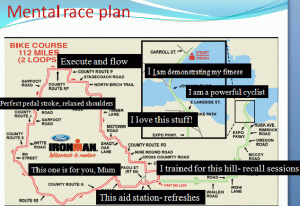
The key to handling pre-race stress and anxiety is four-fold: 1) remind yourself of all the workouts you have done and that you are trained and ready. 2) have a pre-race routine that is totally rote behavior, 3) have a race plan in place, 4) focus on what you are in control of.

1) By the time you get to race day you are trained and ready; you have practiced your warm-up, the race start, your transitions, your race pace/effort, your mental skills, your hydration and nutrition plan, and you know how to do this. You are trained and ready!

2) By race day you have figured out what works for you pre-race and you have a rote set of behaviors you ALWAYS do before a race. You have an iPod with your own playlist on there that is the right mix of motivation and calming music (you want to be psyched up, but not crazed and too amped up so be careful with the music selections!). You know that you like to be in the middle of it all talking to all the athletes, or like me that you prefer a little quiet time, away from athletes who might have a bit too much nervous energy. You take some time to sit quietly before the race, reviewing your race plan, using the mantra/imagery/visualization techniques you have practiced in training. You do the warm up you have practiced to warm up the muscles, check that everything is where and how it needs to be, and to get focused on the task at hand. (I once discovered during my bike warm up that I had put my inserts in the wrong shoes, so left insert was in right shoe and vice versa…). This is a KEY element of staying calm before a race, so take some time to come up with your own personal pre-race routine.

3) You have a race plan that details all of point number 2 as well as all the logistics for the race, from wake up time and breakfast, to parking, pre-race set up, mental techniques you will use, to H and N, pacing techniques (HR, RPE, power, cadence), and where you will meet friends and family after the race. It is VERY calming to have your event laid out like this so that on race day all you have to do is follow the plan. I even list the order I will do everything: for a tri- number marking, transition set up (bags, fluid bottles on the bike, shoes in bags if it is raining, etc), mental prep (sit quietly, review race plan, race visualization), warm up, body glide, wetsuit, breathe deep and calm, water and a gel before I get in.

4) Focus on what you are in control of and don’t let race day conditions take you out of yourself or off your plan: if the water is rough, focus on all the same things you do when you swim in a pool (form, timing of the stroke, pacing, breathing, etc.). If it’s windy, focus on your cadence, HR, RPE, power, and staying on track with H and N. If it’s hot, focus on cooling yourself at aid stations (pour cold water over your head, take ice cold sponges and put them under your clothing, stay adequately hydrated and control your pacing so you don’t overheat). If you get a flat, fix it calmly. We only get in trouble when we hand off control – and on race day we are in control of how we handle every situation and if we feel in control, we won’t panic and get off the plan.

Featured Athlete – Q&A with Eric Levy

Home town: Plainview, NY
Past history of sports participation (kid to adult): I was known as a natural athlete growing up. I played pretty much all sports including baseball, tennis, soccer, hockey, lacrosse and basketball. I loved competition. Growing up, I was most competitive in tennis and hockey. As a teenager, I was a top 10 ranked tennis player in the northeast. Hockey was and is my passion. I played hockey up until about 4 years ago when I started triathlon. I miss hockey very much but plan on lacing up again one day soon.
What was your first tri & what made you do it: My first tri was a Multi Race sprint distance back in the summer of 2008. I was training for an Olympic distance triathlon with Team in Training and wanted to get some race experience before I did an Olympic. I felt the Multi Race sprint distance was a good place to start. I pulled a 1:12 in my first sprint and new I can do better the next time. I was hooked.
Favorite training or racing experiences: I love training in Clermont. I usually train on my own up there. It is my time to get away, enjoy the quiet roads, climb some hills and be grateful for what I have.
Races/events completed recently: Boulder 70.3 (DNF), Disney 70.3 and IM St. George
Favorite race/s (all-time): My favorite races of all time are St. Anthony’s, Nautica and Escape to Miami. I enjoy the city races.
Athletic achievement/s you are most proud of (PRs/Best races): My best racing experience was the 2010 Nautica Olympic. While training for IM St. George, I completed a 120 mile bike ride the day before, stung by a man-o-war during the swim and was still able to pull out a PR of 2:22.
Goals for the coming year/season: After focusing on IM and 70.3 distance racing over the past two years, I will refocus my training on Olympic distance racing next year. As a Certified Financial Planner at UBS, a husband and father of a two year old, my lifestyle can no longer support long distance training. My primary goals for 2012 are to have fun with racing and training; try not to take it too seriously. My plan for next year is to become a better runner and to incorporate other cross training activities.
Favorite racing and/or training tip (what would you tell a newbie): I tend to be a person who goes all in with whatever I do. My advice to newbie’s is “Balance” and to have fun with your training and racing. Take it serious but not too serious.
A favorite “Dara-ism”: Too many to choose from but I will add my motto which keeps me going. “Train Hard, Tri Harder.”

The Way I See It
There is some confusion between the Masters division and Age Group divisions at triathlons (or at least I was confused!). But after a little research, Tim Yount of USAT defined Masters Division for us: “In triathlon, we have categories of awards that many race directors set up to extend the volume of awards given. The most popular happen to be “overall”, “masters” and “grandmasters.” In some cases, they offer clydesdale/athena categories as well (weight based). Masters is designated as being 40-54 for women and 40-59 for men. Many directors award these and then pull out the athletes from the age groups so there is not a doubling up of awards for athletes. Some will even go as far as offering special master’s elite waves where you choose between racing in your five year age group and the master’s elite category or meet a time criteria in order to be eligible to race in that category.”
And that’s that. Questions?

Athlete Race Updates
• Melissa Cohen White did the Dundas Cactus 10k in Canada (where she lives and is enjoying the last of the summer weather) and had a super time!
• Catherine– Ironman Louisville! Woweee! Came out of the water only 12 minutes after the women pros! Had a great bike and held good speed despite the hills, and was running strong till the dreaded “fgastric discomfort devil” attacked her at mile 17. But, determined as ever, she still finished the race in just over 15 hours! Way to go, Catherine. You are an Ironman now!!!
•John unfortunately pulled a calf muscle on his last training run and had to pull out of IML, but is going to do the Great Floridian. He has been experiencing the joys of pool running and this week is tentatively running easy on land. Way to go, John!
•Adam did the Orlando Airport Series 7 mile TT and missed a PR by 4 seconds, which is really rude. But this is coming off a week of being all kinds of sick, so this was superb. He is on track for a sub 1 hour 40k!!!
•Jim is out in Oregon racing the National Masters crit and road race! He is ripping their legs off out there!! Took first place in the Cat 5 Crit and this is only his first year racing!! Road Race is Sunday the 4th.
•Raul continues to race stronger than ever and is seconds off the podium after attacking the peleton the whole time, EVERY race. No-one gets away from him!
•Carol’s metric century was rained out, but she is doing the MS150 this month, despite having a little problem with her foot. She never gives up!
•Melissa Wu did great at the WPB TT and was right on par with her earlier TT’s this year, despite being in a really high volume training phase that is not conducive to fast TT’s. AND she is taking great care of her sick companion animals that means slightly less than optimal sleep.

Upcoming Races:
• Bonnie, Franny, and myself are all doing HIM Augusta.
• Tracey is in a relay gang and will be crushing the swim there also.
• Melissa has a 5k run and a 50k bike “fall Colors” ride coming up.
• Capt Patrick will be doing his first Half Iron in Cancun!
• Paul might be racing for a 5k PR.

Did you Know?
The average age of triathletes is 38.4.
Triathlete Magazine, May 2011

Poll:
While we may not talk about it a lot, all of us who ride our bikes for any amount of time have to eventually ask the question, “How do I get my crotch to hurt less?”


Please do list your favorite cream so the rest of us can try it!
Posted in Blog Entries | Leave a comment

Step Up and Tri – August 2011

Hey there,

I thought long and hard about whether I would write up a review of the ride I did in California last month, The Death Ride, because I did not want to bore anyone with a long saga about how hard it was or how much my crotch hurt at the end. However, I thought that the experience I had and the lessons I learned out there would be of value to those of you training for the most challenging races of your lives.

Just a little background, and to give credit where credit is due to the guy who got me into this; I NEVER would have signed up for the Death Ride, if it were not for my very good friend and best riding buddy, Paul Resnick. Over the last 6 years, Paul and I have ridden
hundreds of miles together in all kinds of weather- crazy hot days with 100 degree + heat indexes, or leg beating 25 mph headwinds (both directions), or rain like something that could have scuttled the ark; through them all we have enjoyed every minute of it together.

Paul is a retired Coast Guard officer (and a former marine) who used to fly fighter jets and helicopters in all kinds of weather and conditions and would think nothing of risking his life to save a few souls in the course of a day’s work. As you can tell, Paul is my hero. He also happens to be 75 years old and this year was the 11th time he has done the Death Ride. When I tell people his age, I can see them thinking that we must ride on the sidewalk at about 7mph, but actually we ride somewhere between 18 and 24mph depending on the day, and Paul looks and rides like a 45 year old.

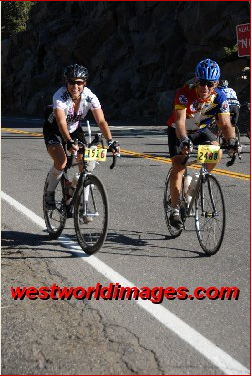
The Death Ride takes place on much of the same course as the Pro Tour of California and starts in the teeny little town of Markleeville, elevation around 6500 feet , and climbs 5 peaks for a total of 15000 feet of climbing over 129 miles. The highest peak tops out at about at 8750 feet and the other mountains are not much lower.

As I could not take the 10-14 days ahead of time that it takes to acclimate to altitude, I decided to fly into Reno (which sounds much cooler than it looks) the day before the Death Ride and took a shuttle into South Lake Tahoe (about 20 miles North of Markleeville). As we drove towards town, the mountains came into view and my anxiety spiked immediately! I had known I was training for a ride in the mountains, but living in South Florida (elevation ZERO), I can’t really conceive of anything over about a 200 foot high bridge span. So, when I saw those snow capped mountains (yes, high enough to still have snow on them) it dawned on me what I had really come to do. I had done all the training I had laid out for myself but I still doubted whether I was up to the task when I saw those peaks. I have never been a good climber anyway, even when I lived in more hilly terrain in N. Carolina, so what on earth was I thinking? These were not hills, these were MOUNTAINS!!! For the first time in my endurance event life, I actually thought I might not be able to do something I had signed up for. I am generally very positive going into an event, so this was a whole new experience for me. I knew that that mindset (doubt and fear) was not going to get me up those mountains the next day. I decided to write this race review because I wanted to share what an important role our minds play in helping us to finish an event.

Rather than tell myself for the next 15 hours till the event that I could not do it, I just said to myself “you will ride till you can’t and then you will rest and then you will ride some more.” After all, all my athletes know I am doing this as I had the smart idea to tell them- I can’t fail!!!! I reminded myself of all the things I have done that were really hard, I thought about all the strength and courage my mother had and the Ironman I did in her honor, I thought of all my athletes who dare to train for events that scare the tar out of them, I thought of how much I love to ride my bike in beautiful places and how lucky I was to be able to do this ride, and I thought of all the support I had from friends and clients and family. Then I picked up my bike from the shop I had it shipped to (they put it together for me- lovely), went to registration, had a beer, had dinner, prepped my bike and fluids, and went to sleep.

3 a.m. and off the alarm went- shower, shave those legs, take care of other business, eat, and off we went to Markleeville. Though I was very nervous, I kept repeating to myself that I would just handle each moment as it came- I would find a comfy cadence, I would ride by keeping within my HR targetsand allow my quads to find the right gearing so that they did not blow up. I kept saying to myself “calling all angels.” Mum was watching, Jan was watching, my best buddy was with me, and friends on facebook were all so supportive. How could I fail?

yes, I CAN climb!

I had always felt I was a lousy climber because I used to try to race up the hills (mainly because I was in a pace-line and I can’t get dropped!) but an event like this is simply about finding your groove and settling in. I had imagined that Paul and I would be at the back of the ride, with everyone pedaling away from us, as most of the participants either had mountains to train on and/or live at altitude- so how could we flatlanders from sea-level possibly keep up?

However, Paul and I were always mid pack and we beat all the time cutoffs comfortably, even though we took our time at rest stops. It was the most amazing sight climbing all the peaks: there was always a long, long line of riders (3500 of us) climbing up the side of a mountain in complete silence- at speeds ranging from 4-9 mph most of the time. During every other event I have ever done there has always been lots of chatter between participants, but not so today. We all climbed in complete silence; all you could hear was the sound of each of us breathing hard and grinding up the mountains. Many athletes found the going too tough and had to stop and get off their bikes.  I have never seen so many athletes on the side of the road cramping up or simply walking their bikes up the mountain- in bike shoes!

Each peak takes between 1.5 and 2 hours of climbing and about 20-30 minutes descending. After you reach the first summit, you strip off various layers of clothing (sleeves, jacket, etc) only to find you need them on the way down. I was going down at such high speed that when I started to shiver I thought I was gonna crash! I spent the day dressing and undressing.

What were the keys to my successful finish?
A long day of climbing has a very different riding style than a shorter ride where you might power over a short hill with a higher cadence and/or stand to power over the top. For this ride, I took a compact crank (even though, I am horrified to admit, that I wanted a triple
crank!) and a 12-28 cassette and I had just about enough gears (although there is one 12% incline at the top of the 3rd peak that I would have liked one more gear for ). The key to finishing this puppy was to carefully control my exertion- all I looked at all day was my HR- I did not have a cadence or pace target, except to find the ones that allowed my quads to feel as loose as possible. I kept my HR in Z2 as best I could all day, with a few forays into Z3 and 4 when the incline just got to be too much and I had to stand or fall off my bike because I was standing still. I only looked at my speed twice- once on such a rude incline that we were all nearly standing still and once on a descent when I saw 57mph and decided I really ought to be looking at the road. My cadence was in the 50’s and 60’s for most of the steeper inclines, with some 70’s when it “flattened out” to a 5-6% gradient. Had I tried to keep my cadence in the 85-95rpm range that I do here for a bridge or the odd hill in Clermont, I would have bonked way before the end of the first climb. I also did not look at distance covered. Actually, that is a lie. I looked at it once and it threatened to de-rail me so I did not do that again. You know, the ride was going to take as long as it took, and as long as I stayed positive and kept on top of my hydration and nutritional needs, I would get it done.

My mind was probably my biggest ally; I stayed really focused on each moment, I thought about my form, I used my mantras, I listened to my breathing, I thought about how gorgeous it was and how extremely lucky I was to be able to go to Cali and do this ride, I thought about how great it was to do this ride with Paul, I thought about all my friends and loved ones who believed in me, I called all angels, and after I got the first peak done I KNEW I could finish. I was euphoric. I did not compare myself to other riders, I did not focus on how hard it was, I did not worry about speed, I did not think about how many miles there were to go. I honestly LOVED EVERY moment of this ride, even though there were some very tough patches. Just like in an ironman or a marathon or any other ultra-endurance event, there are moments when you feel great and times when you feel really bad, but they always pass.

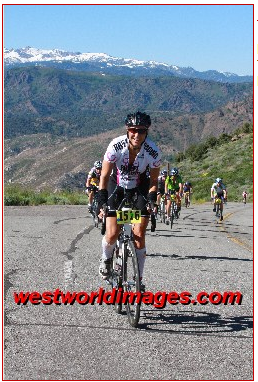
The Death Ride is called the tour of the California Alps and it was truly as fantastic as that name implies. Paul and I got our photo taken at the crest of the last peak and it was a tremendous accomplishment and a great honor- and I whooped and hollered as we pulled into the rest stop at the top of Carson’s Pass.

I think I am a good climber now and I don’t dread hills anymore! I went out two days later to find some more hills to climb- and I think I got a bit carried away as I found one with a 15% grade that had me wobbling all over the place! I rode around Lake Tahoe three days later and the 2854 feet of climbing in 75 miles felt like nothing and I ENJOYED those climbs.We made it!

Thank you, Paul. Thank you, Jan, and thank you to all my friends and clients who supported me and followed my progress. Thank you, Mum, for giving me these legs, this heart, and this great life.
__________________________________________________
Training Tidbit- Is it hot in here?

Performance is always negatively affected in the heat. The optimal running temp is 58 degrees and we have not seen that here since 5 minutes in the morning back in February. Without exception, all my clients are talking about how hot it is and how it affects their workouts negatively. My article “Beat the Heat” (http://www.tricoachdara.com/pdf/beatheat.pdf) talks about what you can do mentally to help deal with the heat, but there are also some other techniques you can use to keep yourself a little cooler during the long, hot workouts that we are all in the midst of.

The jury is out on whether wearing cover ups helps us stay cool, and I think at this point it is just personal preference. I have some clients who swear by their spf sleeves and some who feel like they are in an even hotter sauna even just wearing compression socks. One thing is for sure, you won’t get sunburned and that can be an advantage on a long training day. Whatever you wear, it should be a technical fabric that wicks, not a cotton fabric.

Pre-cooling definitely works, but the logistics of this are tricky (there are not a lot of air-conditioned rooms in the transition area of a tri or while you wait for a bike/road race to start). However, you can supply your own cooling device with cooling neckerchieves or a body vest that holds ice. You can take a look at a couple of examples here: Cooling neck scarves: http://www.healthandbodystore.com/coolingaids.html?gclid=CPu9o-6XvakCFZtd2godGCjGfw . And here: Cooling body vests: http://coolingvest.i4u.com.au/cooling-aids/sporting-vests.htm.

Other things that help a little:
•douse yourself with cold water during the workout.
•re-fill your bottles with cold water during your longer workouts. Plan to run/ride by convenience stores so you can get some ice cold water- it is a really nice pick-me-up when your luke warm (or positively hot) sports drink is suddenly refreshing. (I take concentrated Infinit with me that I fill up with ice water and it is such a treat).
•use insulated bottles so that your drinks stay cold longer, because even with ice in them, un-insulated bottles seem to heat up within 30 minutes.
•Probably the best tool to fight the heat is to get out silly early! Get out for your run at 4 or 5 in the morning. I know this seems extreme but I am way more tired after a run that I did too late in the heat of the day than I am because I had a little less sleep but got my run done by 8am, while there was still shade on the streets and no sun burning a hole in my head.

Stay on top of your hydration and nutrition plan- don’t get behind! Slow down! We simply CANNOT run as fast in the heat as we can when the temp is an ideal 58 degrees. Check out the heat index (combo of temp and humidity) and don’t run when the heat index is going to be 105 degrees or more. Check out this from the national weather service: They consider it dangerous to exercise when the heat and humidity meet (or exceed) the below combinations:

HEAT/HUMIDITY
86° F 90%
88° F 80%
90° F 70%
92° F 60%
94° F 55%
96° F 45%
98° F 40%
(See noaa.gov for the complete chart.)
•Stating the obvious, light-colored clothing will reflect heat, loose fitting clothing will let air circulate, tho some athletes prefer skin tight gear and some studies have found that these do not inhibit evaporation.
•Wear a hat which will block the suns rays, allow you to relax your face instead of squinting into the sun (which will eventually cause your shoulders to rise up and cause poor form and fatigue), and of course you can stick some ice under there too.
•Speaking of sticking ice in things, sports bras provide an excellent shelf for ice, and as Macca demonstrated at Kona last year, tri shorts can hold ice and cold water quite nicely.
•Do your speed/hill work on a treadmill. I know, we all hate the bloody thing, but you will get a MUCH higher quality workout in. Just keep the workout short so you don’t want to stick a pencil in your eye just so someone takes pity on you and you can get off the treadmill.

There is an article in this month’s Runners World that is quite  interesting (and I was consulted for! Whoop whoop!) that talks about some mental tricks you can use to deal with the heat.
•imagine you are running in a freezer, and tell yourself that running in the heat is easier on your joints – you don’t feel as tight.

So, get the right gear, do your long workouts early, stay hydrated and have a good attitude!
__________________________________________________
Monthly recipe

Another recipe to enjoy in the middle of the summer. Light & healthy!
Avocado & Zucchini Burrito
1/4 cup low-fat refried canned beans
1/2 avocado, chopped
1/4 cup zucchini, chopped
2 Tablespoons salsa
1 whole grain tortilla
Wrap beans, avocado, zucchini and salsa in tortilla. Serve room temperature or heat in microwave.
320 calories, 17g fat, 2.5g saturated fat, 0g trans fat, 0mg cholesterol, 600mg sodium, 36g carbohydrate, 11g fiber, 3g sugar, 8g protein.
__________________________________________________
Mental Tidbit: Imagery.

There is a great piece on the use of imagery in this week’s USAT “Multisport Zone” that I think you would all enjoy reading, and if you did not get that email, you can find the article here http://www.usatriathlon.org/resources/multisport-zone/multisport-lab/use-imagery-to-excel-this-season.

If you have read my piece on mental training, you will remember that the type of imagery Dr. Cleere (the author of the USAT piece) is talking about is what I actually call visualization. This is a very potent technique for improving performance and having a great workout or race. What I refer to as imagery is slightly different- it conveys more of a feeling and can also really help you on race day. Of course, if you don’t practice either of these techniques in training, they will be no good to you on race day.

In a study by Orlin and MCaffrey (1989) they found that elite athletes used daily imagery and visualization practice (among other things) to aid their training and racing. Imagery can help you start the race/workout well and keep that feeling going to the end. You can use it to conjure any positive image of strength, endurance, efficiency and speed. Perhaps you could use imagery that conjures a motorcycle for the bike, running like a wolf for the run, and a dolphin-fluid, smooth and powerful for the swim.

Below you will find some ideas for you to start with, but it would be best for you to come up with your own, or to modify my suggestions so that they become yours and they “speak to you.” Whatever you come up with should feel very emotive and immediate. Remember to
practice during every workout.

For the swim
•you are a dolphin
•you are a barracuda
•the feel of the water against your skin evokes feelings of SPEED and ease.

For the bike
•maybe a steam train
•your legs are pistons
•a crotch rocket motorcycle, or
•a spaceship, or
•see your legs moving as pistons- smooth, powerful , unstoppable.

For the run
•pretend you weigh 50 pounds and you are light and free
•imagine your legs are pistons
•that you are riding on a “hovercraft” skateboard (from the movie “Back to the Future”).
•imagine that you are a formula 1 racecar- accelerating out of corners, low to ground, smooth and fast
•your legs are wheels, like the Road runner (beep beep) in the cartoon.
•run like a kenyan/gazelle/cheetah!
•imagine you are being pulled forward by a string that comes out of your hips or your chest.

What can you come up with? Use as many senses as possible and let the imagery flow. During your next workout really give some consideration to what imagery works for you- come up with your own powerful tool!

What works for you to help you feel free, fluid, alive, strong, happy
__________________________________________________
Featured Athlete

Mark Jacobson (in his own words).

I completed the Club Med Olympic race in April, a goal of mine for over a year and a half. When I started, I could only swim a lap, didn’t have a bike, and could only run about four miles. Four miles of leading with my heels and keeping straight as a flagpole. 

The first several months of training for this race were frustrating as I kept injuring myself. I’d done sports when I was in school and back than, could practically do anything physically and still bounce out of bed the next day. But not now.

I needed to do things differently. And. than I did a very smart thing: I asked Dara to help me train. Dara, of course, was just great, greeting me with a big smile, full of confidence. She brought me into her studio, plopped me on her training bike, took some measurements, and gently pointed out about a dozen things I was doing wrong. With this good orientation to her program, I left feeling that I just might be able to do this.

Day after day, I’d follow her customized weekly program posted online, and record my results for her to see in the evening. The next day I’d receive Dara’s comments and feedback, as well as answers to the dozens of questions I asked. She was relentlessly cheerful as well as patient and reassuring about my many lapses. “Life happens.” she told me once after one of them. I liked that one so much that I started using it as my go to excuse for any day I fell short. “Didn’t get to the run portion of this workout, due to life happenings.”

I made several mistakes, especially in the first several weeks, but instead of setting me back or knocking me off my plan, they became with Dara’s oversight, valuable lessons, critical notches in my learning curve.

Through sickness, travel breaks, and a lot of life happenings, Dara never seemed to waver in her belief that I was on schedule and would be ready to go in May. And on my part, I did try to follow her schedule as closely as I could.

Race day finally arrived. The swim–despite jellyfish stings and the constant need to reset my course (I discovered I didn’t swim straight in open water)– went much better than I expected. As I ran to the transition area, I flashed a big smile and thumbs up to my wife. I started biking along the loop course and despite Dara’s many warnings about sticking to my race plan, to my RPE limits (as I’d never really gotten the hang of the heart monitor), I forgot all about that. Instead, excited that I seemed to be in the middle of the pack, or at least not one of the last ones, I began biking faster–racing!–even though I still had many miles to go. Occasionally I would sing a snatch of a song out loud to check my RPE, and as I could still do so, would go even faster.

I finished the bike and with wobblier legs than usual, I set off on the run, faithfully sticking to my bike cadence. But again, I was going fast, faster than my training pace. At the first mile marker I was breathing hard, sucking wind, but at least I’d passed many runners along the way. At that first aid station though, I discovered that they were only handing out water. This was a real setback because I’d assumed, despite Dara’s repeated warnings to check with the race prior, that they’d be serving some kind of energy/ calorie replacement drink. Throughout my training I’d prepared my Heed and would drink from it every ten minutes. Now I was venturing into scary new territory, the deprived zone. All of Dara’s wisdom and teachings about nutrients for oneself, and the folly of not doing so, came back to haunt me as I ran on.

When I looped around at the 3 mile point, I gave my wife a reluctant thumbs up, a wan smile, as the low gas in my tank turned on the warning light . By then, I had slowed way down and runners that I’d left behind were now catching up and passing me. I was huffing and puffing like one of those trains going up mountains in old westerns, and the three miles to go in this almost shadeless golf course, made me feel like I was entering some kind of runners’ purgatory reserved for those unfortunate souls that strayed from their coach’s teachings and wisdom.

By the five-mile mark, I was still running just to say I wasn’t walking; the speed was about the same. I knew I was looking rather pitiful because the amount of onlooker support increased substantially: ‘you’re almost there, just one more mile to go” etc.. However, somehow in that hot sun, that featureless golf course, and perhaps due to race volunteers that had called it a day, I missed a turn and ended up doing one of the big loops all over again, adding about an extra mile.

When I finally crossed the finish line, I didn’t even bother to raise my arms in victory as I’d planned to for my now rather worried wife’s photo shoot. Instead, I just collapsed on the grass and had her pour bottles of cold water over me. One of the Club Med officials came over to make sure I was OK. I babbled to him about the extra mile, the missing race volunteer, but he just looked on with concern, telling me to relax.

As I hope is clear in the above telling, I basically ditched Dara’s great race plan and suffered the consequences. Consequently, I didn’t quite get that sense of accomplishment, that sense of closure that I’d expected. Thus, about three weeks later, I ran the International at Key Biscayne, but this time carefully paced myself, followed Dara’s dictates to the letter, and had a totally different experience. I arrived at the finish line, having just passed several runners in the last mile, feeling energized and exhilarated, and this time, holding my arms high in victory.
_________________________________________________
Race Results
Bonnie – Top 5% in AG and Gender, Nautica NYC Tri! and 2nd place Female Masters, Key Biscayne Triathlon
Michael – NYC Tri – survived the bacteria levels of the Hudson and followed his plan to the T! A perfectly executed race!!
Ralph – Kicked butt at IM Boulder 70.3.
Eric – Had a super strong swim & bike at IM Boulder 70.3 but had to stop racing due to adverse effects of elevation & dry heat.
Fran – 4th place AG, Key Biscayne Triathlon
Julia – She left to cycle the mountains of France. Looking forward to hearing about her trip! She is climbing Galibier!!! And having a croissant and chocolate at the top!!!
Melissa C-W – Weir’s Lane PR last month ( 3 x  1.1 miles of quad busting climbs!) and even splits this month. Also a good race at the Niagara Duathlon. Used this as a great training day!
Adam – Had a great TT, as usual!
Patrick Anderson-45th overall , Key Biscayne Triathlon and a great turnout for my newest newbie!
John – NY Tupper Lake Half Iron- but the race was rained out and too dangerous to do, so he made lemonade from lemons and had a killer 60 mile bike and 13 mile run up there in the hills!
Raul – Races every Wednesday. His power numbers have gone up & he’s close to the podium!

Upcoming Races
Carol – Has a metric century ride coming up. Go girl!
Catherine & John – Ironman Louisville! Big day for these two but training has been going great and they will have great races!!
_________________________________________________
Did you Know?

47% of triathletes have traveled more than 500 miles to race a triathlon (Triathlete Magazine, May 2011). Are you one of them? Please share your experience & what made you make that journey?
_________________________________________________
Poll:

Last month, our poll asked who you thought would win the Tour de France? The choices were Alberto Contador, Andy Schleck, or “Other.” The majority voted for “Other.” Oh, how you were right! That was a fantastic Tour this year. Cadel might have a funny accent but he was AWESOME at this year’s tour!

This month’s poll: Inquiring minds want to know…..

Posted in Blog Entries | Leave a comment

Step Up and Tri – July 2011

Hi Everyone,

The Tour de France, notorious for its epic climbs, begins July 2nd and this is an exciting time for us bike geeks!  Do you fantasize racing up the L’Alpe D’Huez (the place where the Tour is won) side by side with Contador? If so, I’ve got some must-know climbing tips for you:
adapted from a piece by Josh Horowitz of PezCycling News on Active.com

1. Cadence
It is very important to maintain a higher cadence on the climbs as it is more efficient and more effective than pushing a big gear at a low cadence (remember last month’s piece on fast and slow twitch muscle fibers…). A low cadence uses the fast twitch muscle fibers which take a long time to fatigue, so unless you are close to the end of a race, you better save those puppies and use a higher cadence. If you have to run off the bike, this is an absolute MUST do. A higher cadence places emphasis on the slow twitch muscles (fatigue slowly and recover quickly). While it will be impossible for you to hold your cadence at 85-95rpm as you can on the flats, try to hold the highest cadence you can- generally around 70rpms- your stroke should feel smooth and your breathing should remain rhythmic. If your breathing becomes irregular or you start panting, you know you are working too hard!

2. Base Training
Doing thousands and thousands of feet of climbing is not necessarily the best or fastest (or practical) way to achieve climbing fitness. Whether you are training for a 10,000-foot death ride or a pursuit on the track, base training is where it all begins. You will need to build the aerobic base to support the harder work and training for the hills. This provides a solid platform for the rest of the training.

3. Threshold Training
A higher threshold HR or functional threshold power (FTP for those of you with power meters) will improve your ability to climb tremendously- even if you don’t have hills to train on.  One way to do is with 2-4 repeats of 10-15 minute time-trial intervals done at LTHR or FTP.

4. Anaerobic Training
Many athletes, especially touring cyclists and triathletes, ignore the need for training above threshold because their events don’t necessarily require it. By training above threshold level, not only will you improve V02 max and anaerobic endurance, you will also improve threshold power. In addition, it will prepare you to follow accelerations, adjust to grade variations, and power up over the crest of a hill. For those of you training for IM events, anaerobic training will occur in smaller doses- as it takes a lot of recovery from these workouts, and you can’t afford the downtime.

5. Hill training
You can do seated repeats from 1-15 minutes on a hill to build hip and leg strength, you can do standing repeats from 30 secs to 10 minutes, you can do big gear training in a low cadence to build bike specific leg strength (and to simulate to some degree what it will be like climbing at a lower cadence). You can ride hilly courses on a computrainer. Oh, what fun!

6. Positioning (for cyclists)
Start the climb near the front of the pack so you can drift back but stay in contact with the group. If you start near the back, not only will you have to keep the pace of the lead riders, you will have to make the additional effort of accelerating around dropped riders.

7. Pay Attention (for cyclists)
Don’t just look at the move in front of you; try to see two or three moves ahead. Pay attention to everything. Listen to the breathing of the riders around you. Notice what gear they are in and if they discretely shift into a bigger one. Watch out for a rider who seems fresh and is looking around sizing up his competition. Call out an attack so you can get some help from other riders, or make the attacking rider call off the break.

8. Follow Through
Whatever you do, do not sit up as you crest the hill. It’s tempting to think, “Great, we made it to the top, I’m safe.” Riders can lose three bike lengths to the rider in front just as they begin the descent, or they get gapped by the rider in front of them and never catch back on. You’ve done the hard part. Don’t do all that work just to get dropped on the descent. Change into a big gear again as you crest the hill and pedal downhill- this will allow you to get the lactate out of your leg muscles quicker than if you coast down- hill. (Lactate is removed in the blood, and blood flow is higher in working muscles).

9. Get out of aero position (triathletes and time trialists)
If your speed drops below 17mph, you will have more benefit coming out of aero so you can breathe better (you open up your lungs this way) and you can get a bit more leverage by pulling on the bars. The aero advantage is mostly lost at speeds under 17-18 mph. Slide your butt to the back of the saddle as it will give you more leverage again.

10. Focus on your pedal stroke
Even out your stroke- don’t just hammer away at the front of the pedal stroke, but rather imagine that you are pedaling on elliptical cranks so that you utilize the whole pedal stroke and engage all your muscles, while taking some of the pressure off the quads.

11. Find your speed and rhythm
Let your body tell you what it needs- find the speed and cadence that allows you to control your HR. Don’t follow a wheel that is going to pull you out of your zone- because if you go anaerobic you will take longer to recover and you will burn one of those matches I wrote about last month. Keep your grip loose on the bar, as a tight grip will increase your HR (the pressor response).

Ok, so that was the physical stuff, but we all know that is not all that matters when climbing. Your MIND is your best ally! Here are some things to consider to keep your mental wits about you when you’re chuggin’ along:

Change your Mindset. Don’t say to yourself & others, “I’m not much of a climber.” Instead, switch your thinking to “I am a Strong Climber and I Love to Climb!”
Relax and Settle in. You’re going to be there for a while. J Accept it & enjoy the challenge. Take The Pain. It’s never going to be easy. It’s part of the sport we love. Know that the discomfort is part of the process; its just your body doing what you asked of it.
Don’t Look Up! Look down at the pavement at about a 10 degree angle in front of you. From this angle, it will appear to your brain that you are riding on a flat road–and that’s not so bad is it? And you won’t see how far it is to the top.
Smile. It’s that simple. Chrissie Wellington can’t stop smiling! Why not — you’re doing something you love, right? And it will make your competitors wonder how you make it look so easy. J Smiling also tells your brain you are having fun, it relaxes your whole body, and will help you stay loose on the bike.

Recipe
Here’s a healthy recipe for a meal that won’t bog you down in this summer heat!
Garden Lentil Salad Pita
1/4 cup canned lentils, rinsed and drained
2 medium stalks celery, diced
1/2 cup baby carrots, diced
1 lemon, juiced
1 teaspoon olive oil
Sea salt & pepper to taste
1 whole grain pita, cut in half
Toss lentils, celery, carrots, lemon juice, oil, salt & pepper. Serve in pita when ready to eat.
310 calories, 6g fat, 1g saturated fat, 0g trans fat, 0mg cholesterol, 500mg sodium, 58g carbohydrate, 13g fiber, 8g sugar, 11g protein.

Doing an Ironman this Year?
What should you put in your special needs bags? Here are some items to consider:
*Bike special needs: nutrients and anything else you think you might need during the ride—Vaseline, frozen sports drink bottle, gel flask just in case, etc. You pick this up about midway through the ride.
*Run special needs: maybe a change of socks, Vaseline, salt tabs, pain killers (but not NSAIDS), special food, a long sleeved sweater in case it is cold when you run in the dark (tie it around your waist, so you have it). This will be available about half way through the run.

Performance-Enhancing Bracelets – A bit off-balance!
Ok, just admit it. You have one of those hologram stability bracelets in your drawer, don’t you? It’s ok to fess up. They were quite the rage. You saw it for yourself. When someone tried to push you over while wearing it, you didn’t budge. I know. I know. We’re all seeking ways to improve our balance, flexibility and strength but the truth is – these types of bracelets won’t be our magic bullet.

According to a published March 2011 study funded solely by the American Council on Exercise (ACE), the bracelets simply don’t work as advertised and are an absolute scam. The sales demonstrations you see are essentially carnival tricks. By altering the way you apply force to the body, you can easily change the outcome.

The Australian government recently took Power Balance to task because the company has no credible scientific evidence to back up the claims they make. As a result, the Australian manufacturer of Power Balance bands was forced to publicly apologize and admit there is zero scientific backing to their claims.

Meanwhile, in the U.S., Power Balance continues selling their performance jewelry with the same claims as before. The U.S. government has yet to address Power Balance’s marketing claims or those of other bracelet makers like them, but several class action suits have been filed throughout the U.S. against the company citing false advertising and unfair business practices.

For time-proven, legitimate ways to improve stability, strength and fitness, make sure to read our piece below on YOGA!

Featured Athlete: Raul Rodrigues
I asked Raul to be our featured athlete this month, and he decided to write an informative piece instead. Thank you Raul! Great info – read below:

“Knowing where to spend your money for training and racing bicycles.”
By Raul J Rodriguez MD, DABPN, DABAM, MRO

Cycling and related endurance sports can be expensive.  When you decide to compete is when it can get really expensive though, especially with regards to equipment.  Your bicycle becomes an extension of your body when racing.  The better the equipment, the more efficient the ability to transfer power from your body to the road.  Contrary to popular belief, better does not always mean more expensive.  A few things factor into what “better” will mean for you.

The 2 first things you must consider when selecting equipment are the appropriateness and specificity for your individual needs.  We will start with the bicycle frame.  Once you decide exactly what you will be competing in (triathlon, time trialing, road racing, mountain biking), you will select a frame that is designed specifically for the type of riding that you will be doing.

A true time trial or triathlon bike will perform so much better than an adapted road bike.  This has to do with the geometry of those frames, as well as the aerodynamic features.  There actually is a difference between tri and TT geometry.  The more specific you can be the better for you.  For these types of frames you would want to save to get a high quality carbon frame.  You are better off getting a mid-range set of components and getting good aero wheels.  Adding ceramic hybrid bearings to your wheels will reduce your rolling resistance.  Tires for Tri and TT need only be mid-range in quality as they will be rarely used for the hard turns seen frequently in road racing.

If you want to road race, then select a frame with racing specific geometry.  Due to the higher crash risk of these races, you are better off with an aluminum frame or an inexpensive but stiff carbon frame.  You would hate to have to replace a cracked $3,500 frame after a racing crash.  Aluminum frames can withstand most crashes without breaking. A smashed $1,000 carbon frame is much less painful to replace than a $3,500 frame.  Spend your money on getting racing grade components, premium tubular aero wheels and the best tubular tires you can find.  The highest quality tires will outperform lesser tires when subjected to hard turning.  Ceramic hybrid bearings will also help greatly by helping the racer save that little bit extra for the finishing sprint.

If you race mountain bikes, select a quality aluminum full suspension frame that is specific for the exact type of racing you will be doing.  Do not race cross-country with an all-mountain style bike.  Mountain bikes are very specialized in their design.  Selecting aluminum for your frame material with reduce cost and increase durability.  Crashing is a part of mountain biking and carbon frames cannot withstand impact.  On a mountain bike, focus your financial resources on the quality of the suspension system, the components, and the wheels/tires. The benefit derived from reducing the rotational weight of a wheel is most notable on a mountain bike. The correct size and tread pattern of a mountain bike tire also makes a huge difference.

The training tire is a great example of certain equipment choices for training, as opposed to racing, can save you money.  Tire costs add up very quickly if you were to ride expensive tires every day.  This is why you want to buy less expensive, puncture resistant tires that are made with harder, longer wearing rubber.  Use these with a set of rigid, durable, and inexpensive training wheels.  You can save money by patching punctured tubes instead of a new tube for every flat.  Mid-grade bicycle chains perform well and can be replaced more frequently.  Helmets and eyewear can also be of mid-range quality, as they typically perform very well with a small weight and style penalty.  Gloves are optional for most types of bicycle training but should be worn in racing.  These are some of the most widely used consumables that do not need to be of premium quality.

Certain consumables do need to be of premium quality, due to a number of reasons.  High quality cycling shorts, chamois pads, and seats improve comfort and reduce the risk of dreaded perineal injuries.  Shoes and pedals comprise the primary transfer point of power from the rider to the bike.  You cannot cut this corner.  Well made jerseys and other apparel are typically more comfortable and ventilate better.  Nutritional supplements should be well researched and purchased in small quantities until you know how well they will work for you.  Most supplements have been shown in studies to not work and are a waste of money.  I will tell you which ones do work in my next newsletter segment.  Using a coach actually saves you money by making your training much more efficient, which results in greater performance gains for the same amount of your valuable time used for training.  But if you have read this far then you probably knew that last bit already.  A professional bike fitting is always money well spent as a good fit will improve performance and reduce the risk of repetitive motion and positional injuries.

Financial resources are limited for most people.  Efficient allocation of resources when training and racing will optimize your performance and save you money.  Spending in the right places will prevent you from being at any significant equipment disadvantage with the big budget racers.  Your well chosen equipment will level the playing field.  You will do the rest.

Did you know…?
32% of triathletes do yoga (Triathlete Magazine, May 2011)
Are you one of them? If so, that’s great. I’m sure you’re experiencing the benefits of this fantastic discipline. If you’re part of the other 68% that don’t, well then, this is for you. I understand your schedule is packed with swimming, biking, running, working, family, etc so that’s why I’m just asking you to incorporate the three poses below into your routine:

Eka Pada Rajakapotasana (Pigeon)

This pose is probably the best hip opener in yoga. It helps open the deep muscles of the hip and the hip flexors. To do this pose, start in Downward Dog.  Lift your right leg up and sweep it through to your mat, folding it and placing it on the mat. Keep your right foot flexed to protect the knee. Your left leg is straight behind you with the toes pointed. Keep your hips square and level, with the left hipbone pressing toward your right foot. Inhale and press your hands into the mat, getting as much length in the spine as possible. Exhale as you walk your hands forward on the mat, coming out to your edge. This might be on the elbows, with the arms extended all the way out or right where you started. Hold this pose for one minute. Remember to breathe! Switch sides.

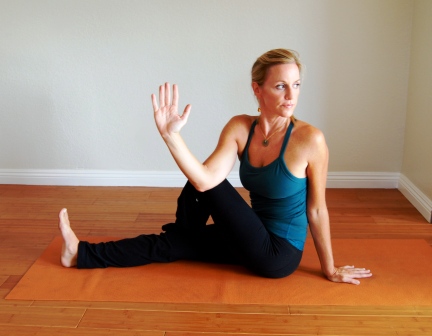
Ardha Matsyendrasana (Half Lord of the Fishes Pose- great name!), variation

This twisting pose is excellent for creating balance between the left and the right sides of the body, for opening up the chest and torso, and for opening up tight hips.

Sit tall with both legs extended in front of you. Make sure you are sitting evenly on your sitting bones. If your hips are very tight, sit on a block, or folded blanket until you can sit with a straight spine. Bend your left knee in and place your foot on the ground on the outside of your right thigh. Place your left hand on the ground behind your sitting bones, as close to the back as possible. Inhale and reach your right arm straight up. Exhale and twist to the left, rotating from the waist. Place your elbow on the outside of the left quadriceps and gaze out over your left shoulder. Hold for one minute and switch sides.

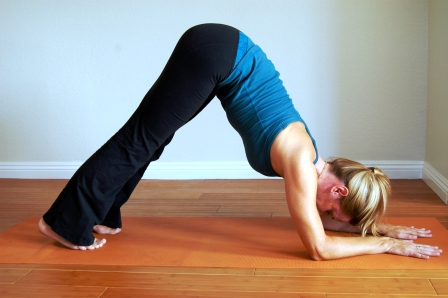
Dolphin Pose

This pose is excellent for opening up the chest, shoulders and the hamstrings. It also mirrors the proper upper body alignment for cyclists.

Start on your hands and knees, with your knees directly beneath the hips and hands slightly in front of your shoulders. Exhale and tuck your toes under, pressing your tailbone toward the sky. Keep your knees slightly bent to start. Press your heels toward the ground, it is okay if they don’t reach it. Lower down onto your forearms, with your elbows directly beneath your shoulders. Broaden your shoulder blades away from each other. Breathe deeply and hold for one to two minutes.
(source, http://www.active.com)

Race Results:
Melissa C-W – did big SYd and bested her past times and was very close to negative splitting the repeats. She will do it next month!
Adam – was within 15” of his goal and set a PR for the 40k TT on his bike. this is the ride of truth and is SO hard.
Jim Redgate – took 6th on the Clermont hills last weekend! And this is only his 3rd race!
Melissa Wu- took 1st in AG at the WPB TT in June.

Upcoming Races:
Bonnie- Mack Cycle Olympic
Frannie- Mack cycle Olympic
Eric- Clermont Olympic
Orando- Sprint triathlon
Carol- Triangle Tri (sprint)
Julia- leaves to ride the great climbs of the Tour at the end of July! She will be out there actually on the Alpe D’huez!!

They way I see it:
How about this for good form? Note: slight forward lean, good knee and arm drive, head position is perfect, and you can tell she is moving! Go, Sue, Go!

Poll:

Have a great month! If any of you would like me to research and then write about a particular topic, please let me know!

Once again, thank you to Melissa Wu for helping me with this newsletter- she does the bulk of the work!

Dara
TriCoachDara.com

Posted in Blog Entries | Leave a comment

Sizzlin’ Summer Wetsuit Sale from XTERRA!

Through June 30, 2011, you’ll get the following deals using CO-DARA at checkout:

Volt: $99 (reg. $200)

Vortex 3 Sleeveless: $139 (reg. $300)

Vortex 3 Fullsuit: $179 (reg. $400)

Vector Pro X2 Sleeveless: $199 (reg. $400) Vector Pro X2 Fullsuit: $275

(reg. $600)

Vendetta: $500 (reg. $750)

Velocity-M Speedsuit: $175 (reg. $200)

Transition Backpack: $45 (reg. $70)

Posted in Blog Entries | Leave a comment

Beat the heat

Beat the Heat!

You can perform better in the heat if you acclimatize your body, but there is more to training and racing in the heat than the physiological training; you gotta train your mind too!

 Go to http://www.tricoachdara.com/articles.htm and read the article “Beat the Heat” to learn more about the benefits of specific pychological preparation for racing in the heat.

Posted in Blog Entries | Leave a comment

Step Up and Tri – June 2011

It’s June already!
How did that happen? At the beginning of the year, it seemed as though we had ages till our big races but they are creeping up on us. Some of you just marked 6 months till your key races, and some of you are MUCH closer to the big race/s of your season. I hope that training is going great and you are feeling strong and confident.

I just got back from a super Century ride in horse country, south of Gainesville, as I prep for the biggest, gnarliest ride I have ever undertaken: The Death Ride- a tour of the California Alps on July 8th — 129 miles with 15,000 feet of climbing. Yes, I have indeed lost my mind! I decided to do this ride because I SUCK on hills and thought I needed something to inspire me. It may be fear or smart training that gets me out to do my training rides for this puppy, but I hope to see some of you out there.

May you find the following tidbits interesting ….

Just “Step up and Tri!”

Dara
___________________________________________________________________
Training Tidbit-
How a higher cadenced riding will lead to a stronger bike AND run – trust me.
Why o Why does Dara keep harping on about cadence drills this, and spinups that, and increase your cadences all the time?

It all boils down to the makeup of our muscles and slow vs. fast twitch muscle fibers. As counter-intuitive as it sounds, our slow twitch muscles are the ones responsible for higher cadences (because these will generally be done with a lower resistance/less force application than fast twitch muscles fibers).

Slow-twitch fibers:

  • Primarily burn fat for fuel, an almost limitless supply (tens of thousands of calories) for even the leanest athlete.
  • Are very resistant to fatigue: they take a long time to fatigue and recover very quickly.
  • Produce less force and do so more slowly than fast twitch fibers.

Fast-twitch fibers:

  • Burn glycogen (stored form of carbs) for fuel of which there is a limited supply- somewhere between 1500- 2000 calories of muscle glycogen for a well-trained, well-fueled athlete.
  • Produce high force, very quickly.
  • Fatigue quickly, and recover slowly.

Hunter Allen and Andrew Coggan (THE source for all things power related) have developed a nifty analogy: Imagine your legs are a book of matches and every time you dig deep and go really hard you burn a match. The total number of matches in the book is finite, just like your energy supply. Once you burn a match, it’s gone. At the beginning of the day you have a full set of matches, but each hard effort your do burns one of those matches. Those hard efforts are all powered by the fast twitch muscle fibers. Spinning at a higher cadence allows you to hang on to those very valuable matches.

If you try to climb or ride at a high pace with a low cadence (high force) you are most definitely using up those fast twitch, powerful, quick to fatigue matches. Where will you be when you hit the final stretch and none of those matches are left? You will be left riding (or running) slowly. Or, worse than that you may just bonk as those fast matches used up all your muscle glycogen….

The issue is NOT just one of spent matches, however. For cyclists, holding a higher cadence will allow you to respond to an attack more quickly, as you know you can’t explosively initiate a sprint from a really big gear- you have to be in a gear that will allow you to take advantage of your power- and that will take higher cadences.

For triathletes, a cycling cadence of around 90 rpms actually matches their running cadence, which facilitates running off the bike. And of course, if you pushed a big gear with a low cadence all the way through the bike leg then you definitely used up a lot of muscle glycogen and spent a lot of matches and Voila!- Concrete legs that don’t run well!

What is the optimal cadence? Studies have generally found that it is around 85-95rpm. Of course, there are times when this is too slow (sprinting)  or too fast (climbing a big hill). Experienced, stronger cyclists will be comfortable within a wide range of cadences.
___________________________________________________________________
Nutrition Tidbit –
What’s the hype about carbohydrates & what is their role in performance?
As endurance athletes, we use two primary substrates for energy- carbohydrates (stored in the form of liver and muscle glycogen, and present in the blood as glucose) and fat (you know where this is stored!).

The typical athlete has about 1200-2000 calories of stored carbs  (if they have been eating well), and if we burn between 600-900 cals an hour, you can see that we will run out of this energy source pretty quickly. This is why triathlon is really 4 disciplines: swimming, biking, running and nutrition.

What about fat? This is an almost infinite supply of energy (literally tens of thousands of stored calories), but at exercise intensities greater than 40% of VO2max the human body will preferentially begin to use glucose or glycogen to produce energy. This is because carbohydrates are metabolized very quickly, whereas fats must undergo a much more complicated and time consuming process to produce the zoom zoom in your legs. The higher the intensity, the more your system will burn carbs for energy.  Additionally, fat burns in a carbohydrate flame, so even when you are working at low intensities, carbohydrate is still being used (in small amounts). Actually, we are never just using one substrate; there is always a mix being metabolized.

So what!? Because you don’t want to bonk! We can’t actually replace the glycogen at the same rate that we burn it during exercise as we can only process about 60g of carbs /hour(240 cals). This means that long course triathlon or cycling events over 2 hours have a lot to do with resource management- with regards to both the expenditure (pacing) and the intake of energy. Pacing is vital for longer events as is ensuring you are optimizing your intake of carbs in a way that works for you. If you would like a copy of my workout hydration and nutrition document that details all the things you need to consider for your nutrition strategy in training and racing, please email me (dara@tricoachdara.com).
___________________________________________________________________
Athlete’s Races Updates

Bonnie and Franny– Mud run, Miami. They had fun!!! But not as much fun as we are gonna have at the Tough Mudder in December!

Melissa C-W– Big Syd Climb: Melissa was shooting for negative splits up this nasty 1.2 mile climb in Canada and she did it! Very happy with her time, she has already set new, challenging goals for this puppy next month!

Adam– WPB TT. Decided not to do that race, but is going to do two the first week in June: Team Armada 4.1 m and Orlando Airport series (7 or 14 mile) TT’s! He is also training for a sub 60 minute 40k-er at the end of June! Go, Champ, Go!!!!

Tracey– Gulfcoast Half Iron! Tracey had a super race and is ready to do Augusta in September. Last year she got a flat and her “wrench” had put the wheel skewer on so tight she could not get it off and that was the end of the race.  THIS year, she raced strong and hard to the finish!

Orlando– Ironman St.George. This was Orlando’s first IronMan, and he was ready despite fighting with some serious tendonitis. Orlando finished this race, in spite of having the stomach flu and throwing up for much of the race. I don’t know how he managed to complete arguably the toughest race on the US circuit. But now he can say he is truly an Ironman of the toughest order. He still wants to race IM Florida at the end of the year…. And I know he is gonna kick some serious iron booty!

Jim– Naples Road race. Jim took 8th in his first ever road race, which is amazing! Jim is training for Nationals in Oregon, so wish him luck!

Raul– I don’t know how he does it, but he races every Wednesday and kicks it hard! The last race in May he took 7th and we are determined to get him on the podium! He is getting stronger and smarter each week. Way to go, Doc!

Melissa W– Florida 70.3, 5:45. A nice steady training race.

Mark-Club Med Olympic- This was Mark’s first Oly distance race, and he did so well, despite running an extra mile or two due to poor race instructions and a lack of volunteers on the course. He is ready to race another Oly as soon as possible, but this time he wants his time to reflect the right distances!

Upcoming races:
Melissa C-W has another round with Big Syd as well as a duathlon or two.

Liz S will be doing the Mack Cycle Du in June. She will make the Dawgs proud!

Adam, as I mentioned will be taking on the ultimate race of truth, with a 40k TT. Ouch. But with his latest power numbers we know he can do it!

John is going up to New York State to do the Tupper Lake Half Iron, and he is gonna show those northerners just what a Floridian IronAthlete can do. (Ok, John is from New York, but he lives here now….)
___________________________________________________________________
Are You Mentally Prepared?
What gets you through those rough patches out there on the course?

One of the best tools to help us deal with the inevitable “dark moments” during racing (and training) is to have a plan in place for when these moments arise (because they WILL arise). You should practice a couple of different techniques in training so that you can easily call upon this on race day, because if you have not practiced it, it will NOT work on race day – you won’t be able to access it.

My fave tool to banish the demons, I imaginatively call “100”. (I thought it was all mine, but then I read an article that Paula Radcliffe uses it too. I came up with it first, but I can’t run a 2:18:55 marathon…)

100: Use this for tough times during training and racing. Keeps negative thoughts out of your head, takes your mind off pain, yet still lets you focus on the task at hand and helps you find your rhythm.

With every out-breath, count until you reach one hundred: out-breath = “1”, out-breath = “2.” If you lose count, simply start again.  Sounds silly simple, but it really works.

Mantra- Come up with your own version. When things get tough, you can replace negative thoughts and self talk with these short mantras. Again, these take your mind off discomfort and give you something positive to focus on. Here are some of my athlete’s mantras that work really well for them:

“piece of cake”,  “fast, fluid, fresh,”  “Fierce,” or  “steady and smooth.”

What works for you?

Note, it has to ring true for you- if not it will grate on you and won’t work. For instance, while I love to run, I am a back of the packer so when I first came up with my mantra “Fit, fluid, fast, and strong” it did not work because I would get all caught up and negative about not being fast. And as you know I get very upset if anyone complains they are slow. So I changed it to “fit, fluid, smooth and strong” and it works great for me.

Some common self talk errors: Focusing on the Past or Future, Using the Negative, Focusing on Weakness during Competition, Focusing only on Outcome, Focusing on Uncontrollable Factors, and Demanding Perfection from  Yourself.

Instead, we need to focus on:

  • the present (associative thinking),
  • use the positive as we talk about what we can do/are doing,
  • focus on our strengths during competition,
  • focus on performance goals (how we do it)  not outcome goals (whether we podium or not- as this depends on so many things beyond our control)
  • focus on what we control (pacing, H and N, mental outlook, form, etc)
  • compassionate evaluation of how you are doing. Demanding perfection will prevent greatness.

___________________________________________________________________
Pic of the Month
Dara's Running Speed Group 2011

The last day of Run Speed Group — what a great bunch!!! I can’t wait till the next one! ___________________________________________________________________
Client Corner – Bonnie Barr
Let’s see, I got back into running and triathlon after I had kids, well, about 10 years after I had kids — lol! I met Kevin (my boyfriend) about 4 years ago and he was doing tri’s, I was so psyched because I really wanted to become active again in the sport and needed the motivation and a training partner. My first race was a Tradewinds sprint tri in 2009, and then jumped into Florida 70.3 a couple months later. I remember saying to Kevin after the 70.3, “I will never, ever, ever, ever do an Ironman” he was laughing at me so I asked him to write it down in case he forgot, but I was dead serious! Since then, I have done a lot – 1 marathon, 7 half marathons, another 70.3, several sprint tri’s, 1 Olympic tri, and lots of 5K’s. And now I have even done the unimaginable…signed up for Ironman Florida !!  I don’t remember the exact moment I decided to sign up, or what possessed me to do this damn race but I’m pretty sure it has something to do with my BFF Franny, who’s doing it with me and the other 12-15 people doing it with us..and no, I wasn’t coerced into it while drinking heavily ! 🙂

There are 159 days left until Ironman Florida and I am so excited (and scared) to be doing it. Everything I do from here on out including Nautica New York and Augusta 70.3 is to get me fully prepared for a strong finish in my first Ironman.

Working with Dara has been an amazing motivator. I’ve seen so much improvement and I’m so grateful to have her to help me through this. I could NOT be doing this well without her, and I’m secretly looking for races early into next year so I can keep working with her longer.
___________________________________________________________________
Did you know….?

39% of triathletes are women.
Triathlete Magazine, May 2011
___________________________________________________________________
Ask me anything.

Comment on this blog or visit my Facebook page to chat with me!

Posted in Blog Entries | Leave a comment

Welcome to Step Up and Tri!

Welcome to my Blog!
I’ve always wanted to send a newsletter to my athletes. Just something quick & informative to help my clients with their athletic journey. Then I realized I already had a blog in place where this content could be distributed in the fastest, most helpful way. Plus, it can be an open forum where we can all share ideas, so if there is a topic you would like to get more information on or you would like to add your observations/experiences in the newsletter, now is the time! The newsletter will go out once a month and will generally feature short pieces on training, gear, nutrition, mental skills, and then a “Client Corner” where I’ll focus on one of my athletes & you all get to be the stars!

Melissa Wu is helping me with this task, so loads of thanks goes out to her for making this little idea of mine actually come to fruition. How she finds time to do this in between saving all the homeless, abused animals in Palm Beach County, and taking first place at FAU’s triathlon this past month, I don’t know.

I hope you enjoy our new “Step up and Tri” newsletter.

Dara

Training Tidbit
Wetsuits: When & where to use them. Is it safe to train in them in the hot summer?

While the rest of America may still be solidly entrenched in wetsuit weather, down here in Florida, I would say we are done with the wetsuits until December. What if you are traveling to a race up North, should you take your wetsuit with you? I vote yes if the water is going to be below 78 degrees or if it is questionable. Better to have the suit and not need it than to encounter 75 degree water and wish you had it. And remember, you can still wear a wetsuit in races if the water temp is between 79 to 84 degrees; you simply won’t be eligible for points.

Whether or not you wear a wetsuit is going to depend on the individual:
Pros: While you may not save any time wearing a wetsuit in a short swim (due to the added time in transition), you may indeed go faster in the water for less energy, it is much easier to deal with rough water in a wetsuit, and if you have practiced taking off the wetsuit, then you won’t lose much time in
transition at all.

Cons: If you are a strong swimmer, you find it hard to get out of the wetsuit, the water is calm, it’s a short course, or you feel constricted in your wetsuit, then I would not wear one as the amount of time you save may well be lost taking the thing off in T1. Try it both ways in your practice bricks and decide for yourself.

For longer distance swims the wetsuit is certainly a benefit- your body position is more streamline and saves energy, and it is MUCH easier to deal with rough water, and of course you will be faster in transition if you are not so cold coming out of the swim. For many athletes the wetsuit makes for
increased confidence and perception of speed- so go for it!

Always practice in your wetsuit before race day so you know where to apply lube so you don’t get a painful wetsuit hickey and so that you have practiced both pulling it up high enough (to minimize the feeling of being constricted) and getting out of the damn thing! I have often found that athletes do not take the time to inch the suits up high enough (front and back) and this can really make you feel as if you are being strangled. I swim better when not being strangled. You?

Nutrition Tidbit
It seems we all need help on this one.

How much should you really drink on the run? That will depend on what you are doing and where you are doing it. We can take in both more calories and liquid when we bike and less of both when we run, due to the higher metabolic costs of running than biking. Even though we burn more calories running, we generally can’t process those calories as well both because of the bouncing motion of running and due to decreased gastric blood flow at higher intensities.

You have to experiment in training (at the same intensity and in the same temperature as both of these will alter how your system processes what you put in your gut) to figure out how much you liquid and calories you can tolerate. The range is 20-33oz of liquid and between 100 to 240 cals. Some athletes will fall outside this range, but they will only know by experimenting in training.

Biking: I drink a little over a bottle an hour when the temp is over 80. My liquid has my calories also: 224/hour. What is your preference?

Run: 3.5oz/10 minutes and I get 150 cals/hour from that liquid.

Athlete’s Upcoming Races – Go Get ‘Em!
Bonnie – Mud run, Miami. Military style obstacle course. Fun stuff!
Franny- Mud run, Miami. No tutus today, ladies.
Melissa C-W- 10k in Canada. Coolish up there.
Adam- WPB TT. Gonna show those S. Floridians how they do it in Sanford!
Tracey- Gulfcoast Half Iron! You go Girrrrllll!
Orlando- Ironman St.George. Oh yeah! He is ready for those hills!
Jim- Naples Road race. Taking it to the big dogs…
Raul- He’s crazy and races every week!
Melissa W- Florida 70.3 AND Escape from Alcatraz! Damn, she’s tough!!
Mark-Club Med Olympic- his first!!!

Are You Mentally Prepared?
One of my new favorite tools– the mental map with strong, positive self talk written on it- you can then recall each statement as you pass that spot during the race:Mental Race PlanClient Corner
Hi everyone. This is Melissa Wu. This month, Dara asked me to write a little something about myself to kick off the “Client Corner.” It’s my honor to be included in this newsletter. I’ve had the privilege of being coached by Dara for almost two years and I’ve had the even greater honor of being her friend. I hired Dara just weeks before my first Ironman in 2009. I was a bit freaked out to say the least. In true Dara-style, she smacked me straight, gave me the tools I needed to compete at this distance & cheered me on like there was no tomorrow! I’m forever grateful to her for making that first IM such an amazing experience & can’t wait to see what she and I can pull off this year! I’ve got three key races coming up: IMFL 70.3, Alcatraz and IMAZ. I know Dara doesn’t want this “Client Corner” to be just athletes tootin’ her own horn but since I’m helping her publish the Blog, I can get away with it I wonder who she’s going to pick next month? Stay tuned.

Did you know …..?  http://www.thepostgame.com/lifestyle/201104/which-sports-do-more-americans-participate

Ask me anything?
Soon, I’ll have a Facebook page so we can stay in touch even more. Keep an eye out.

Posted in Blog Entries | Leave a comment

Welcome !

Mid winter and the rest of the US is freezing and digging out from under feet of snow. Here in South Florida we just have to deal with the winter wind.  Its so RUDE! I KNOW! But wind is what we have here because we don’t have hills (or snow 🙂 ). I know we all say we hate the wind, but we have to get over it.

Handling the wind is mostly a mental game; the sooner we stop saying we hate the wind (which is a veiled admission of defeat), the sooner we can learn to use it as a a great training tool. Let go of the need for speed, and embrace the need for maintaining a high but comfy cadence, desired training heart rate (different for different training rides), and related RPE, and we can ride strong in the wind. It is a great mental training tool, in that we can focus on form and feel, and be disciplined about not trying to hold a certain pace, and still have a great workout. Don’t let your focus on keeping a unattainable pace into the wind ruin the workout. Take control of the ride- make sure your goals fit the conditions, and then adjust what you focus on so that every workout is a good one.

Posted in Blog Entries | Leave a comment