Step Up and Tri – April 2013

Welcome to April’s Blog.

Racing season is upon us! Had a whole bunch of athletes start their seasons off with a big bang- they have been training hard and consistently and it has all paid off. So exciting to be a part of that!

While there are a lot of you who receive this newsletter/blog who are working with me currently, there are plenty of you who are not working with a coach. What are some of the things you should consider to help you with your training? There are 4 principles of training that guide how I write my athletes’ plans: individuality,
specificity, overload and reversibility and you should consider these too.

Individuality: we are all different! If you are training with your buddies and just tagging along for their workouts, then you are missing some of the fundamentals in training. You might be the same age and be doing the same races as your best buddy, but that is where the similarities probably end. How quickly you adapt, what your HR, power and pace zones are, how much rest you need, how much time you can devote to training, and what your strengths and weaknesses are will all affect the type of training you should do. Often I get athletes who say, “so and so is doing a group ride 3 or 4 times a week and getting stronger and he never takes a rest week, so why can’t I train like that”. My answer to that is, “imagine how much stronger so and so would be with some targeted training and appropriate rest!” DON’T just do what your friends are doing. Do what YOU need to do to get better. Consider your strengths and weaknesses and how those relate to your target race. (Often a strength or weakness does not apply when you consider the race. If I am lousy at hills but my target race is on the flats, then my weakness for climbing is no longer a liability. Or if I am an excellent swimmer, but my target race is in a current assisted river
with a time trial start, then I will have lost some of my advantage as everyone will have a better swim). Study yourself, keep a training log, and figure out what you need to do to get better.

Specificity: is vital when training for races. What is the duration, terrain, weather, and other specifics of your target race? If you are doing an ironman then a bunch of VO2 workouts won’t have a lot of application for a race that is done at a mostly low aerobic intensity. Training exclusively on flat terrain when your target race is hilly will leave
you in trouble on race day. Hydration and nutrition needs to be tailored to both the intensity you will be racing at and the weather: the harder you race and the hotter the weather, the less tolerant your stomach will be too foods and fluids. You have to practice specifically for race day.

Overload: this is how you get fitter! We have to apply a stimulus that is greater than what we can already handle in order to get stronger. That can be in terms of volume or intensity. It is the constant application of overload (and appropriate rest) that allows us to become stronger. I remember when I first started running and signed up for a marathon. On week one I found a 5 mile run rather challenging, but with the constant and consistent
overload provided by the weekly long runs and increasing training volume I was able to run 26.2 easily at the end of 4 months of training. Several of my clients have had superb increases in the FTPs with the use of the principle overload: we build the duration of time at FTP and voila – a bigger, fatter FTP ensues. We have to push ourselves past our current tolerances to get stronger. But we also have to target those efforts, based on where our fitness is currently. Time trials allow us to establish paces, power and HR zones so that we know how hard to make the training sessions. If you don’t base your training on that data, the overload might be too low or too high. The first one will lead to stagnation and the second one can lead to injury, overtraining or burnout.

Reversibility: Use it or lose it. After time off, we will have lost some fitness, and the amount we lose depends on the amount of time off we had. If you have a forced lay off from training, don’t come back and assume your fitness will be right where it was when you stopped training. Start easy and re-build the base (interestingly, we lose our aerobic adaptations faster than we lose our anaerobic conditioning), and then progress onto the more advanced workouts (tempo, threshold, anaerobic work). We have to train consistently to maintain our fitness. On again and off again training will not result in increased fitness and makes you more susceptible to injury. So keep at it! Besides, we love this stuff, so why would we stop?

If you are coaching yourself this year, keep all of this in mind! Good luck at the races!

Athlete Race Update:
Kristy: Nautica! Great race- 6th fastest swim, 2nd fastest bike and a strong return to running after only being back to it for 7 weeks!
Sue: yet another PR at Corral Springs half mary!
Nadia: PR’s at both NYC and Corral Springs Half Marys!!
Colin: podium finish at Bradenton Oly and a blazing 5:07 at his first half Ironman (Texas). Way to go!
Rich and Sean did corporate 5k’s in the midst of some busy scheduling and put in good times.
Adam got a PR on his corporate 5k!

Upcoming Races:
Cicily and Jason are racing at FAU and maybe Sue too!
Bonnie, Franny and Nathan are all doing the Boston Marathon- whoo hoo!
Cicily and Colin are doing St. Anthonys- always fun
Kristy is doing HIM in St. Croix!
Cat and Sean are doing Clermont HIM!
Sandy and Liz have a 10k in venice beach
Bernie is doing the Deefield beach sprint.

Born to be a trail runner
http://well.blogs.nytimes.com/2011/03/18/born-to-be-a-trail-runner/

10 Ways Yoga Boosts Your Endurance Training
It starts with an in-breath and ends with a longer stride. Here are some simple ways the right stretching will get you across the finish line.
Joshua Berman for Men’s Health Magazine.

Marathoners, ultra-race trainers, and yoga instructors agree to a T — regular practice of Hatha yoga breathing exercises and asanas, or poses, should be an integral part of any endurance race training regimen. Why? Well, the benefits are mental, physical, emotional—and undeniable to those who have tried it. So whether you’re training
for the Leadville 100 or the Marathon des Sables in north Africa (a six-day, 156-mile ultramarathon, equivalent to six regular marathons!), the message is clear: start stretching now. Here are 10 reasons why.

1. Breath
Breathing practice is essential to Hatha yoga, some would say even defined by it. Practitioners use a back-of-throat nose breathing called ujayi pranayam, or “breath of the victorious warrior,” which lengthens inhalations and increases lung capacity. This, in turn, delivers more oxygen to the body and helps with overall performance and efficiency. (See numbers 4, 5, and 6 for other benefits.)

2. Stride
To cover more ground with fewer steps, you need loose hip flexors, lubricated joints, greater hip flexion, and properly stretched hamstrings — all of which are common results from regular Hatha yoga practice. Many asanas cover these areas, which help develop a longer natural stride and smoother, steadier pace.

3. Endurance
“At the end of a marathon, the body is totally spent and depleted of fuel,” says Jai Sugrim, Certified Jivamukti Yoga teacher and host of Yoga Sutra Now. “It is the mind that brings you home to the finish line,” Endurance requires equal parts physical and mental strength, and yoga (in addition to fitness) helps with concentration. During the final stretch of a race, you can use meditative techniques to push negative thoughts aside and focus on getting your butt across the finish line.

4. Core
Abdominal strengthening, says Boston-based yoga teacher, Karen Fabian, founder of Bare Bones Yoga, “is one of the most important things to keeping a body strong, centered, and powerful.” Most Hatha yoga series include such core strengthening poses, which do more than just hone your six-pack. A strong core supports the body from the inside out, improving running posture and protecting your back and hips.

5 . Mental toughness
Holding a yoga pose for a long time — especially a core-trembling, quad-shaking position like “warrior” or “chair” pose — not only strengthens muscles, but it also builds confidence, quiets the mind, and translates directly to race day, says Scott Rodwin, founder of Radiance Yoga in Boulder, Colorado. “Over time,” he says, “the practice of
simply holding the pose teaches you that you are stronger than you think. The asana asks you to overcome self-limiting thoughts and the fear of pain. It requires discipline and commitment.”

6. Focus
Athletes who are out there on long, solo training runs already know about developing an inward, mindful state of being, a.k.a. “the zone.” Staying mindful of your breath helps achieve this, says personal trainer Carrie Jesse, allowing athletes to stay in the moment and “even match the rhythmic breathing to their footfalls.”

7. Flexibility
Tight hamstrings, calves, glutes, and lower back muscles are all common side effects of many endurance race regimens. “Hatha Yoga helps immensely in releasing tight muscles and restoring full mobility to the body’s joints,” says Alexander Cortes, a strength and conditioning coach at a UFC gym in California. “Often times endurance racers will unknowingly develop bad movement patterns due to tight muscles. Mobilizing and realigning the body [with yoga practice] can restore proper patterns and prevent avoidable injuries.”

8. Recovery
The restorative power of yoga counters the constant pounding on your legs and spine, while also helping develop and maintain a sense of space in the hips and lower back. In addition, the increased oxygen coursing through a yoga-enhanced athlete’s body means less soreness and quicker tissue repair after you push it.

9. Injury prevention
Yoga promotes a constant awareness of what is going on in your body and mind. Many classes begin with a reminder to honor your body’s particular needs and limits on that particular day. “Yoga helps with your ability to discern between discomfort and pain,” says Sage Rountree, author of The Runner’s Guide to Yoga. “This is an important distinction as the hours and miles wear on your body.”

10. Strength
Yoga uses your own bodyweight as resistance to build strength. “People don’t realize yoga is work, it’s a physical practice,” says Taj Harris, endurance runner, yoga teacher, and Crunch Group Fitness Coordinator. Poses require strength as well as balance, she says. “Honestly I’m rarely on the weight floor in the gym. I use yoga to strengthen.

Featured Athlete:
Sean Tibor
Past history of sports participation:
I grew up swimming, from the age of 12 through two years of college. I was a middle distance freestyler and swam well, but never at a national level. About 7 years ago, I ran my first half marathon. Prior to this point, my attitude was “I don’t/can’t run.” Not only did I find that I actually liked running, I liked
hanging out with other runners and people who raced as adults. It was a lot more interesting to me than joining a company softball league.
What made you want to compete in triathlons? When my wife and I first moved to Florida two years ago, I thought a lot about the life I wanted to have in our new location. With the beautiful year round training weather and easy access to the water, triathlons seemed like an excellent way to get out and enjoy our new home, especially since I could swim and run already. How hard could biking be? It took me another year until I learned one of my colleagues was training for a half-Ironman and saw how interesting it could be. Then I did the unthinkable: I signed up for a half-Iron without having any idea of how I was going to get to the starting line.
What was your first tri & what did you learn? My first tri was the Escape to Miami olympic distance race last September. The most important thing I learned was not to wear my wedding band when I swim in open water! My “starter” band is now sitting at the bottom of Biscayne Bay. (Reward if found) I also learned how much of this sport is mental. You have to find the things that keep moving you forward, whether you’re tired, upset, in pain, or sick. And you have to know when to chuck your race plan and adapt.
What surprised you most about how it made you feel about yourself? It wasn’t the triathlon, it was picking up my race packet for my first marathon in February. When I
first started running, the people that trained for the full marathon were the “crazy ones” that trained way too much every week. Who had time for that? When I picked up my bib and saw all the other half marathon bibs out there, it struck me that I had crossed over and was now one of the “crazy ones.” The change happened gradually, but that was the first time I realized I was doing something very different than almost everyone I knew.
Do you think that training for triathlon has affected other areas of your life?
How? Absolutely! I’ve certainly become much more disciplined in my daily schedule and found more energy from the early morning workouts. I never thought I ‘d be the kind of person that wakes up at 4:30 to pull off a brick workout before work, or plans my day around making it to the pool in the evening. When I was swimming in college, I always had trouble making it to morning practice. Now I feel lazy if I miss a single workout.
What are you most looking forward to this year in terms of training and racing/events year? I’m looking forward to the Florida Challenge 70.3 in a few weeks as my first A race of the year. My wife and I are expecting our first child at the end of May, so I’ll be cutting back the amount of time I spend training while we have a new baby girl. Focusing on speed and power should pay off when I return to longer races later this year. I hope to find my way back into those big races once the dust settles.
What has endurance training and racing taught you? There’s something really powerful about setting a goal that you don’t know you can attain at the start. It helped me remember how to dream big again and take risks. It’s easy to focus on the daily small
improvements in your life or set goals that aren’t really inspiring. But big risks lead to big results.
How do you mentally approach a race? Races are the big event, the culmination of months of training. I get excited, nervous, scared, brave, and obsessed with my races, especially as they get close. But it’s not about the finish time, at least not yet for me. Being a new triathlete, I’m very focused on getting to the starting line and crossing the finish line. It’s the excitement and energy of racing that really stay with me after the race, as well as that feeling of accomplishment when you find a way to make it through a really tough race. I try to take it all in when I race and store those memories and feelings for later.
Favorite racing and/or training tip (what would you tell a newbie, and not necessarily something Dara told you!) You have to run your own race. Find the things that you love about this sport and focus on those, even if they’re silly. After all, it’s pretty unlikely that we’re going to race in the Olympics or angle for a podium position at Kona. You have to create your own podiums and your own records. And when you conquer
those, make more.
A favorite “Dara-ism(s)” I think my favorite is when Dara asks how my “leglettes” are doing, which reminds me of piglets. I’m 6’3″ and 205 lbs. There’s really nothing cute or little about my legs, but it does make me smile.

Do you suffer from cramping calves?
Thanks to Colin Goldsmith for finding this article to include this month.
http://www.tri247.com/article_2371.html

A feel-good story to keep us going
http://online.wsj.com/article/SB10001424127887323419104578374870179274496.html?
mod=WSJ_hp_EditorsPicks#articleTabs%3Darticle

Recipe:
Vegetable Tofu Scrambler
Tofu is high in protein and calcium, low in fat and sodium, and cholesterol-free.
Ingredients:
1/2 medium onion, 4 – 5 mushrooms-sliced, splash of olive oil, 12-ounce pkg firm tofu, crumbled 1-2 tsp curry powder, pepper (to taste), salsa (to taste), 2 stalks green onions
Directions:
1. In a large saucepan, add the onions and mushrooms to a splash of oil and saute on medium-high heat until the onions are translucent. Crumble tofu and add to saucepan. Add the curry and pepper. Sauté 10-12 minutes until moisture has evaporated. Add salsa and green onions and scramble on high heat for 2 to 4 minutes.
Note: you could also add any other veggies you have kicking around.
Makes 3 servings (approx 4 oz each.)

This is your brain on exercise:
http://well.blogs.nytimes.com/2010/07/07/your-brain-on-exercise/?emc=eta1

Five commandments of Time Trialing:
http://library.constantcontact.com/download/get/file/1102662744069-732/Five-Commandments-for-Time-Trialing-by-Lisa-Colvin.pdf
Posted in Blog Entries | Leave a comment

Don’t miss the 6th Annual Pedal for PAL Bike Tour!

Please check out the event flyer for information. Proceeds go to the PBC PAL program.

Posted in Resources | Leave a comment

Costa Rica Retreat – don’t miss out!

Don’t forget about the upcoming yoga and healing retreat Kristina Jensen and Lori Klinger are leading at Pura Vida Spa and Resort in Costa Rica.  The dates are May 26-June 1. Spots are filling up quickly so please contact them to hold your space. Please see CostaRicaretreatmay2013 for further information regarding the retreat.

You can also visit kristinajensendc.com and click on the Costa Rica page for information and to place a deposit.  A 50% deposit needs to be made by March 24th. Please contact Kristina or Lori if other arrangements need to be made.  This is going to be an amazing week of yoga, Reiki, Theta Healing and meditation.  The resort is a beautiful spot for healing and rejuvenation.  If you are unable to attend, please feel free to share this information with others who may be interested!  Lori can be contacted at 850-496-0056 or downbythesea33@gmail.com and Kristina can be reached at  561-876-8577 or KLJensen7@hotmail.com.

Posted in Resources | Leave a comment

Step Up and Tri – February 2013

Welcome to February’s Blog.

I think I was surprised how fast time was flying at the end of last year- and look at this, February is nearly over and I have yet to get a blog out!

The end of the season and some time away from training gives us time to think about what we want to accomplish next year- what races to pick and goals to target. I find that many athletes have trouble coming up with the best races in which to show off their strengths and improve on areas of weakness, so here are some tips for planning out your season.

1.     Figure out your goals for the year- do you want to try to qualify for Nationals, aim for a PR in your favorite race, or simply hit a destination/bucket list race?  Pick two major goals for the year, and these will help you pick other races appropriately. These other races can be tune up events, or maybe just some fun with friends (as long as the timing is right and it does not interfere with essential training for the A race/s (there should only be 2-3 of these. And they should either be 8 weeks apart, or for short course athletes, they can be grouped over 2-3 weeks).

2.     When do you typically perform at your best- early or late season? If you like it cool and live in SoFla, perhaps an early season A race is good- so you can train through the winter. Or if you prefer more racing as training and more training with friends, perhaps a late season race is better.

3.     What type of course do you excel on? Do you like lake swims that are wetsuit legal (cos you get seasick in open water- anyone we know….? 🙂 ) or do you prefer a kick butt hard, ocean swim so you can show off your swimming prowess? Do you like hills or flat? Windy, cold or hot? Figure out your strengths and pick a course that caters to it. Figure out your weaknesses and pick a course that won’t show them up- OR that forces you to address them!

4.     Do you like destination races that are combined with a holiday, or is it better for you to race closer to home for the convenience and support factors?  Remember, Ironman branded races sell out in record time, so you need to plan a year in advance for those. Some of the smaller races are not as hard to get into and will be cheaper.  Planning a year out lets you save up some money and look for cheaper accommodation too.

5.     Is altitude or time difference going to be a factor for your destination race? Altitude can begin to affect performance at around 5000 feet, and it takes about 10-14 days to fully acclimate. If you can’t get to the venue that much in advance then it is better to arrive as close as possible to the race start so that the negative effects of altitude are minimized. Until you are acclimated, you are simply negatively affected and arriving 3-7 days in advance will simply hurt your performance due to fatigue, dehydration, sleep disturbances, elevated HR’s, and elevated reliance on carbohydrate substrates.

Jet lag: more than three time zones can be very challenging! You can try to adapt to the destination’s time zone at home to get a head start on it. Also, pay attention to the direction you are traveling: If you’re traveling east and want to adapt to the new time, you will have to wake up earlier and go to bed earlier than you normally would. This is known as advancing your body clock. If you’re traveling west, you’ll have to adapt to the new time by waking up later than usual and going to bed later than usual, delaying your body clock.  Controlling jet lag is fundamentally about controlling light and darkness: if you are traveling east, you must expose yourself to light early, advancing your body clock so that it will be in sync with the new time zone. Conversely, if traveling west, you should expose yourself to light at dusk and the early part of the evening, delaying your body clock so that it will be in sync with the new time zone. Also, stay away from alcohol and spicy foods for the first few days.

Heat: also takes about 10-14 days for the body to acclimate, but at least we can do this at home (in Florida we are ALWAYS heat acclimated it seems, but that is actually not true. Think about how you feel when the first truly Floridian hot days arrive…). To acclimate  you can simply wear more clothes if it is not hot outside. When acclimating to both heat and altitude, initial workouts should be shorter and easier. Then you can add some distance and lastly add some intensity over a 10-14 days period. Stay hydrated!

6.     For races leading up to your A race, make sure you pick races that meet available family and work schedules and budget.  I suggest you use local as training races so travel is minimized, training is disrupted the least, and there is less stress attached to the race. Choose a reasonable number of races that actually contribute to your season’s main goal/s in some way. These “B” and “C” races will allow you to practice all the elements of your A race and can be “trained through” (meaning less of a taper and recovery, and more of a workout). These races will let you gain more experience, practice pacing, hydration and nutrition, mental skills, try out new/different equipment, and simple race logistics.

7.     Remember, if you race too much, it actually cuts into training time- especially if you plan to taper and recover for those races. So you would actually lose fitness racing too much! “C” races can be trained through (minimal taper and recovery) so your training is not impacted too much. But you need to consider how tired/sore you are post race and what that will do for the next week of training. It is often, therefore a good idea to put a C or B race at the end of a training block before you enter a rest week. Some races with friends as “throw-away” races are fun and will remind you why you do this.

8.     Recovery from sprint races can be anywhere from a few days to a week, Olympic distance in about 1-1.5 weeks, half-Iron in about two weeks. Full Iron distances, about 5 to 8 or more weeks is typical full recovery times- but for some athletes it can be longer and for novices it usually is much longer. You can workout during these recovery times, but it should be done at a lower intensity without the same training goals. The point is just to go have fun and recharge the batteries. There are many factors such as nutrition, age, lifestyle, and fitness level which affect this recovery time so it will vary from individual to individual.

Lay out your calendar so you can really see how it all fits in your life and how each race affects and relates to the A races. You’re A races inform the whole season, and dictate what your training objectives are and this should help you come up with your schedule for the year. And of course, your coach will be advising you!

Athlete Race Update:
*Sue Caplan
was a marathon maniac: racing her first marathon at the Palm Beach Marathon in December, Goofy Challenge (a half marathon on Saturday and full on Sunday), and capping it all off with a PR at the A1A marathon in February! All that and still walking! Without a limp!
*Bonnie, Franny and Nate did the Palm Beach Marathon, as well as the A1A Half Mary. The weather was a lot nicer for this February race than their December race!
*Colin came in 29th overall at A1A Half Mary this past weekend- his first.
*Sean Tibor finished his first marathon at the A1A also.
*Nadia raced really strong in a 10k in 29 degree weather in NYC in January.
*Liz and Sandy ran great at their first 5k of the season this month too.

Training/Nutrition Tidbit: Triathlon is really 4 events: swimming, biking, running, and your hydration and nutrition plan.  Make sure you dial it in, practice with it AT RACE INTENSITY, and in the heat conditions likely to be experienced on race day. The following study demonstrates the efficacy of following a scientifically sound nutrition and hydration strategy. Simply put- we are all faster when we eat and drink according to sound scientific principles! http://www.ncbi.nlm.nih.gov/pubmed/22587540

Featured Athlete:
Carol Thompson
, who has been my client and friend for 10 years!
Past history of sports participation:
I was on the tennis and track team in High School way back when. Those were the only 2 sports girls could be in to compete with other schools at that time!
What made you want to compete in triathlons? My wonderful husband and I found ourselves being my Mother’s primary caretaker after her stroke. The first morning we were at my mother’s house, I sat down at the table opened the paper and there she was… Dara and her wonderful smile! In the article she said she could take a couch potato and in a few weeks make them a Triathlete! I just thought, “mmm… I can swim, I can run, I can ride a bike, all I got to do is win this contest! I really did not want the same health issues my mother had and my family health history suggested that was was going to happen. I knew I had to change it and that I had the power to change it; just didn’t know how! Dara knew how and I knew that. P.S. I won the contest!
What was your first tri & what did you learn? My first Tri was in Richmond, VA in July of  2003.
What surprised you most about how it made you feel about yourself? The euphoric feeling when I crossed the finish line. In fact I get the same feeling every time, just like it was the first time! When I crossed that line all I kept saying was “I did it, I did it!” And my family was there to watch!
Do you think that training for triathlon and long bike rides has affected other areas of your life? If so, how?
The training really helps me to focus on balancing my life. The long bike rides are just fun, especially  when you talk to someone and they tell you about a pretty road out in the country somewhere and your first thought is “I wonder if I could bike down that road” or, “I have been on my bike on that road!”
What are you most looking forward to this year in terms of training and racing/events? I hope to do my first century ride and my first 1/2 Ironman with Dara!
What does endurance training and racing mean to you? I have discovered that it is much more satisfying to say the you are training for something than to say you exercise. 🙂
How do you mentally approach a race? I like to treat all the races and events like it’s the only one I’m doing, cause I can then just focus on it and try not to get worked up.
Favorite racing and/or training tip (what would you tell a newbie, and not necessarily something Dara told you!): Have fun and enjoy yourself… YOU WILL FINISH!
A favorite “Dara-ism(s)”: 1.  YOU CAN DO IT!!!!! 2. Carol, PLEASE PLEASE PLEASE write in your log!

Erica Goldstein submission:
Glucose Uptake by the Cell, Type 2 Diabetes Mellitus, and Cinnamon
The average athlete does not suffer from insulin resistance but understanding this medical condition sheds light on the physiological underpinnings of glucose uptake by the cell. Type 2 Diabetes (T2DM) differs from Type 1 diabetes in that T2DM is a progressive disease. In a Type-2 diabetic person, insulin is still being secreted from the pancreas; however, this function is greatly diminished. In addition, insulin resistance in peripheral tissue (muscle, adipocyte) develops and impedes the amount of glucose (sugar) that is absorbed into the cell. This is the reason for the higher than normal blood sugar levels in a T2DM person. In Type 1 diabetes, the beta-cells of the pancreas are no longer secreting insulin and that is why these individuals must receive insulin injections.

Insulin is a hormone that is released from the beta-cells of the pancreas. Muscle and adipocyte (fat) cells rely on insulin to stimulate glucose uptake by the cell (i.e. sugar absorption). A common misunderstanding with T2DM is that insulin is no longer able to bind to the surface of the cell and stimulate the uptake of glucose, which results in high blood sugar. In fact, in T2DM insulin is still released from the pancreas and does still bind to its receptor on the cell; however, the problem occurs downstream within the cell.

Glucose Transporter 4 (GLUT 4) is exactly what the name implies – a protein that is able to move to the surface of the cell membrane (i.e. cell surface) and transport glucose into the cell. The glucose can then be metabolized and used as a source of fuel for exercise.  In a normal healthy individual, this action of insulin in conjunction with GLUT 4 moves sugar out of the bloodstream and into the cell, which helps to regulate blood sugar levels. However, what occurs with T2DM is insulin resistance. Carbohydrate is eaten, digested, absorbed, and released into the blood, which triggers the release of insulin from the pancreas. Insulin binds to the receptor on the cell but GLUT 4 is not able to properly translocate to the cell membrane and pull sugar into the cell. In this scenario, blood sugar levels will continue to rise, more insulin will be secreted, and additional stress is put on the pancreas, which results in damage to the beta-cells and a diminished ability to secrete insulin. That is why T2DM is considered a progressive disease and state of insulin-resistance.

Inflammation is a chronic condition in obese persons and negatively interferes with signaling mechanisms within the cell and subsequent ability for glucose to effectively move from the blood plasma into the cell. Enter cinnamon. Consuming cinnamon extract will not prevent this type of inflammation but rather in the state of inflammation acts to enhance the action of insulin and the chemical signaling that occurs within the cell (i.e. movement of GLUT 4 to the cell membrane). Cinnamon, therefore, may enhance movement of glucose from the blood into the cell in a person with T2DM.

Athletes are driven by the love of sport. However, convincing a pre- or Type-2 diabetic, who is sedentary, to engage in physical activity can be somewhat formidable. Persons with T2DM have the ability to secrete insulin; therefore, exercise (in addition to diet) is the best form of therapy for increasing insulin sensitivity and managing blood glucose levels. Exercise is recommended because it results in a net movement of sugar out of the bloodstream and into the muscle cell. Exercise will enhance insulin sensitivity in muscle tissue and is a result of both an increase in GLUT 4 activity as well as number of GLUT 4 transporters, which helps to increase glucose uptake by the cell and reduce blood sugar concentrations. Moreover, exercise in addition to diet may enhance weight loss, which can also contribute to increased insulin sensitivity and glycemic control.

In conclusion, exercise is as always the best form of medicine. Athletes may also benefit from cinnamon because it possesses certain phytochemicals that may act as an antioxidant in the body.

Add 1 tbsp. of cinnamon to plain cereal like oatmeal and cheerios, or try these tips for incorporating cinnamon into daily life:
-Add a cinnamon stick to rice as it simmers for a Middle Eastern flavor
-Include 1 tsp. of cinnamon with coffee beans and grind together

References:
-McArdle WD, Katch FI, Katch VL. Exercise Physiology: Energy, Nutrition, & Human Performance. 6th Ed. Philadelphia, PA: Lippincott Williams & Wilkins;2006:439-453.
-Gropper, SS, Smith, JL, Groff, JL. Advanced nutrition and human metabolism. 5th ed. Belmont, CA: Wadsworth Cengage Learning; 2009:73-74, 264, 276.
-Wellen, KE, Hotamisligil, GS. Inflammation, stress, and diabetes. J. Clin. Invest. 2005;115(5):1111-1119.
-Qin, B, Panickar, KS, Anderson, AA. Cinnamon: Potential role in the prevention of insulin resistance, metabolic syndrome, and type 2 diabetes. J Diabetes Sci Technol. 2010;4(3):685-693.
-Nelms M, Sucher KP, Lacey K, Roth SL. Nutrition therapy & pathophysiology. 2nd Ed. Belmont, CA: Wadsworth, Cengage Learning:2011:482, 500.
-Mayo Clinic web site. Is it true that cinnamon can lower blood sugar in people who have diabetes? Available at: http://www.mayoclinic.com/health/diabetes/AN00939. Accessed January 25, 2013.
-The spice barn web site. Cinnamon recipes: taste tips. Available at: http://www.spicebarn.com/cinnamon_recipes.htm. Accessed January 25, 2013.

Nutritional Tidbit:
http://www.staradvertiser.com/news/20120612_Artificial_sweeteners_Doubts_by_the_teaspoonful.html

Recipe:
Tofu & Vegetable Stir-Fry with Peanut Sauce


INGREDIENTS:

  • 1 cup brown rice, cooked or 1 cup quinoa, cooked
  • 1 pound extra firm tofu, cut into cubes
  • 2 teaspoons of olive oil
  • 1 yellow onion, sliced thinly
  • 1 carrot, chopped
  • 1+ cup green beans, with ends cut
  • 1 clove garlic, minced or crushed
  • ½-inch piece fresh ginger, minced
  • 3 or 4 TBSP peanut butter
  • 5 TBSP water
  • 2 tsp. lemon juice
  • 2 TBSP soy sauce or tamari
  • 2 TBSP soymilk

INSTRUCTIONS:
1. Pan saute the tofu in a non-stick skillet pan until the tofu is lightly browned (5-10 mins). You may add a teaspoon of oil, or you can just pan fry with no oil in a nonstick pan. Remove from wok/pan.

2. Heat 1-2 teaspoons of olive oil in the wok and stir-fry the onion, carrots, and beans for 4 minutes or so – until the beans start turning a bright green and the onions become translucent.

3. While this is cooking (or even beforehand), add a small amount of oil in a separate pan and add the ginger and garlic. Cook for a minute or two, then stir in the peanut butter and then the water. Stir until smooth. Add the lemon juice, tamari/soy sauce, soymilk, and stir well.

4. Return the tofu to the wok, and stir in the peanut butter sauce. Mix well and serve on top of the rice.

Always time for a laugh:
http://www.youtube.com/watch?v=p1yi3oxB-4s

Posted in Blog Entries | Leave a comment

Step Up and Tri – December 2012

Welcome to December’s Blog.

As you all know, I was off in Nepal for a month, chasing a 40 year-old dream. As a 7 year old in England I saw a movie with my Mum, called The Lost Horizon, and I loved it so much I dragged her to it at least 7 times. That was my first encounter with Nepal and I wanted to go right then and there. At 17 I realized I could actually get there, yet I let it slip away. Every year I found a reason not to go, and before I knew it, 40 years had passed. 2012 started off with a tremendous amount of loss and reached the tipping point for me when my best friend, Lee, died. I was on my way to her memorial when I was in a head on collision in rural N. Carolina- where both the other driver and I could have/should have died, or at the very least been seriously mangled. The longest 30 seconds in my life were as I climbed out the back passenger door (the driver’s side of the car was destroyed) and ran back up the road, certain that I had killed the other driver. Earlier that week I was sure things could not get any worse, but as I was running round that bend, seemingly in slow motion, I felt like I was in a nightmare where things just kept falling apart. To my relief, as I rounded the curve I saw the other driver walking towards me and we both escaped with minor injuries. Initially I felt like it was just one more thing in a string of loss and bad luck,
but then I realized that this was actually a sea change- exactly because no one was dead or seriously injured. And of course I realized that this was one hell of a wake-up call. Life can change in a split second- it can be over or so dramatically changed as to be unrecognizable. So just what, exactly, was it going to take for me to chase the dreams I had had since I was a child? I needed no more incentive, and booked my trip to Nepal that week.

The trip could have been anti-climactic with all that build up, but it surpassed my expectations and allowed me to cap my year with tremendous positivity. Nepal showed me that you can turn anything around, and it allowed me time to heal and to process and to lay some old ghosts to rest. I had a tremendous amount of time to myself in which simply to think: once on the trek I was hiking in solitude for 6-8 hours a day, and then in my sleeping bag by 7pm usually with nothing to do but journal and read. One of the high points of the trip was to hang prayer flags for all the people I have lost, and for those people my friends have lost, at 17000 feet at the top of Larke Pass, deep in the Himalaya and that felt like an honor. I built stupas in honor all those people, and I thought about the love and support of all my friends and clients who have buoyed me up all year and proven to me that life is empty without good friends. I feel like the luckiest woman in the world.

I travelled through villages that seemed as though I had stepped back 500 years in time and played with children who have nothing, yet grin and look you in the eye with the most incredible innocence and openness. The villages up in the mountains showed me what true subsistence living is all about- if supplies can’t get there carried in on foot or on the back of a mule, then those supplies aren’t coming. Simplicity. (Easy for me to say of course, as I am
not the one who has to exist in that subsistence way of life- but honestly, the villagers seemed content and were so welcoming.)

Many of you are chasing other dreams: racing dreams, ironman dreams, sub hour 40k dreams, marathon dreams, and it very much feels like the pilgrimage that Nepal was to me. Who knows when these dreams first take root, but they grow and grow till they can’t be ignored, and when you finally decide it’s time to commit it will be one of the best journeys you ever undertake that will teach you much more than what you can do physically. It will teach you about your mental toughness and what really matters, and just where the edge is and that you can in fact jump off and simply get stronger. And just like Nepal, it is not the final destination that is important, it is being present in every moment- even the unpleasant moments (filth, food poisoning, physical hardship, the joy of squat toilets and no running or hot water for 16 days …. ), and toughing it out and smiling all the way through because it is a once in a lifetime experience, outside the pale.

So, whatever it is you are chasing, don’t wait any longer. Make it happen as soon as you can and watch it transform your life and teach you so much more about who you are and just what you can do. Endurance training and racing is so much more than putting in silly amounts of hours swimming, biking and/or running- it is a journey to yourself, and I bet you like what you find there.

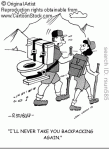
Hiking Cartoon

Nutrition Corner:
Understanding the Role of B12 in Endurance Exercise by Erica Goldstein.

Vitamin B12 is the one vitamin that can only be obtained from animal sources, such as
fish (especially shell fish), beef, poultry, eggs (the yolk in particular), and dairy. B12 serves two main functions: promotes effective nerve transmission as well as proper red blood cell
formation. B12 is consumed in the diet from animal sources and requires the acidic
environment of the stomach for digestion, release of the vitamin, and absorption, which is a
complicated physiological process. Athletes that consume medications of a chronic nature to reduce or slow acid secretion in the stomach (i.e. to control acid reflux) should have their levels of B12 monitored periodically.

B12 is required to help support the integrity of the myelin sheath that coats and
protects nerve cells. Nerve cells create the impulses that allow your muscles to function. The myelin sheath can be related to the casing that covers the common cable cord in any
household. This casing ensures an effective transmission of the electrical signal from the outlet to your television for continued viewing without interruption. If this casing was compromised then maybe your TV would start to flicker or in worse cases viewing would be totally interrupted because the cable could not efficiently transmit the electrical signal from your outlet to the TV. In a human, the interruption in nerve cell transmission can manifest as loss of balance, tingling in the extremities, fatigue, and mental confusion. In fact, a deficiency can occur over several years and lead to irreversible damage to the nervous system. Therefore, adequate absorption of B12 from the diet is essential for continued health and performance.

In the role of red blood cell formation, B12 assists folate, another B vitamin, to remain in
its active form. Folate must be in its active form for DNA synthesis to occur, which is necessary for the proliferation (i.e. division) of red blood cells as well as appropriate formation of the cell. If a B12 deficiency occurs, a particular type of anemia results and this can negatively affect both health and performance because red blood cells are required for performance through their capacity to carry oxygen to cells and also remove carbon dioxide. Oxygen is of course necessary for energy production. In conclusion, carnivores obtain the B12 they need from consuming varied sources of meat, fish, and eggs, in addition to dairy.

Vegans and some vegetarians may have a more difficult time but many foods such as soy milk and cereal products are fortified with B12. The possibility of consuming a B12 supplement also exists. The recommended daily amount of B12 for adults is 2.4 micrograms (µg) per day. A 3-ounce serving of salmon has 2.4 µg, a 3-ounce serving of beef has 2.1 µg, 8-ounce glass of skim milk has 0.9 µg, 1 large egg has 0.6 µg, 3-ounce serving of chicken/turkey has 0.3 µg.

Recipe: The following is a homemade trail bar adapted from the Meal Makeover Moms, http://mealmakeovermoms.com/recipes/snacks-smoothies/grab-and-go-granola-bars/. These bars can be made with B12 fortified oats and cereal and they freeze well and can be easily stored for quick access to nutrients post-workouts. Moreover, this recipe makes 12 bars and each contains 200 calories, 9g fat (1.5g saturated, 0.9g omega-3), 30g carbohydrate, 3g fiber, and 4g protein.

¾ cup quick cooking oats
1 cup Shredded Wheat cereal
½ cup walnuts
¼ cup ground flaxseeds
1 cup dried fruit (any combination)
½ tsp. cinnamon
½ tsp. salt
2 large eggs
1/3 cup honey
1 tsp. vanilla extract
½ cup dark chocolate chips

Place the oats, Shredded Wheat, walnuts, dried fruit, cinnamon, and salt in a food processor
and pulse until the mixture is finely chopped (fruit should be the size of a pea). In a large bowl, whisk together the eggs, honey, and vanilla. Add the oatmeal mix and chocolate chips. Stir to combine. Transfer the mixture to the pan and flatten down. Bake 18-23 minutes or until the edges turn golden brown. Mmm mmmm, good.

A retreat good for the soul
Our friends Kristina Jensen and Lori Klinger are hosting a Healing Heart Retreat in Costa Rica this May. Please check it out. It’s going to be an adventure of a lifetime!

Always time for a laugh
http://www.youtube.com/watch?v=zfvpzkGfpEA

Posted in Blog Entries | Leave a comment

Step Up and Tri – November 2012

Welcome to November’s Blog.

Does anyone know how on earth it got to be this late in the year? Did this year fly by for all of you?

For all my athletes, October and early November, see the last A races of the season.  You have all been training for many months, maybe even a full year, and it is with excitement, and some relief, that you actually get to do the race. (Or not, in the case of those of you who were in New York this past weekend. So bummed for you all!!!! Some of you will now be extending your seasons through early December for the WPB Marathon- so close!)

All that hard work, all that sweat, all those nights when you stayed home so you could get up early to train, all that planning, all that logging of workouts, and balancing family time with training time, eating healthy, figuring out the logistics for the long rides and runs, all the sore muscles, and all the great training sessions alone or with friends will finally come to fruition for many of you in the next couple of weeks.

Hopefully the journey this year has been fun and you learned something about yourself; not just what you can do physically, but what you are made of mentally and emotionally, and maybe every spiritually. Training and racing gives us so much- therapy, challenge, quality time by ourselves or with friends, and a way to commune with the world and discover who we are.

As the season draws to a close, linger a while and think about what you have learned on all these levels and how it changes or affects how/who you are in the world. What does your training give to you? Training and racing is fun and tough and exhilarating and challenging and I love it. And if you are reading this, I bet you are a believer too.

What do you want from training and yourself next year?


As many of you know, I’m in Nepal for a month of exploration and adventure. This is a trip I have dreamed about for 30 years, and finally decided it was time to make it happen. I will be thinking about you all while I am out there, especially those of you racing while I am away. Sorry I won’t be at your races, but I know you will make yourselves and your coach very proud.

Thank you all for your support, trust and hard work this year. I am a very lucky woman and not a day goes by that I don’t count my blessings.

For those of you who are interested, here is a link to the site that follows my progress.
http://www.findmespot.com/spotadventures/index.php/view_adventure?tripid=316104

“What is adventure? If a lone wolf lifts his plaintive call into the moonlight near your campsite, you might call that adventure. While you’re sweating like a horse on a climb over a 12,000 foot pass, that could be adventure. When howling head winds press your lips against your teeth, you face a mighty struggle. When your pack grows heavy on your shoulders as your climb a 14,000 foot peak, you feel the adventure. When you suffer freezing temperatures and 20 inches of fresh powder on a hut to hut trip in the Rockies, that could be called adventure. But that’s not what makes an adventure. It’s your willingness to conquer it, and to present yourself at the doorstep of nature. That creates the experience. No more greater joy can come from life than to live inside a moment of adventure. It is the uncommon wilderness experience that gives your life meaning and context.” 
– Frosty Wooldridge, Golden, Colorado

Athlete Race Update:
*Kristy and Ralph did the 3 gap 58 mile HILLY bicycle ride in Georgia and kicked some butt! Kristy was one spot shy of a podium finish. Not bad for a girl from the Florida flat lands.
*Colin aced his first ever tri at Tradewinds and pretty much raced a perfect race. He’s in a tough AG and still came 9th in it and 70th overall.
*Adam raced hard at the State TT – as always gave his full on effort. Missed the goal by a smidge, but will be back for it next year.
*Mark also raced hard at State 40k and next year will be shooting for a sub hour finish, but still beat his goal by 2.5 minutes.
*Rachel Vanness almost had a PR at the Delray 5k, but with a fever and no sleep the night before was off by a few seconds. I wish I could race that well when I am sick!
*Rachel W did her first IM at the Bridge to Battleship in North Carolina with her boyfriend, Sean. They aced the race and she is feeling great! Can anything ever top the feeling of the first time you hear those words “You, Rachel Whipple, are and IRONMAN!”
*Cat Trejo did her 2nd Ironman at IMFL this past weekend, so she can tell us how it feels to hear those words more than once! She just missed a sub 13 hour finish! Way to go, Cat!!! A 1:08 swim, without her goggles for the first lap! And nearly 18 mph on the bike.
*Julia did the Dolphin Challenge and held 23mph for most of it and felt great after. Can’t top that!
*Sandy and Liz did the PAL half Mary- I don’t have the results yet! But I know they had a great time.
*Nadia raced the PAL 5k and did great!

Upcoming Races:
*Kristy and Colin are racing the Olympic distance and Sean is racing the Half at Miami Man next weekend. Good luck you guys!
*Of course, Bonnie, Eric, Franny, Nate and Sue were all up in NYC to race the New York Marathon, so they are disappointed but not beaten. Bonnie, Fran and Nate are doing the WPB mary instead. While Sue is gonna do the Goofy Challenge (half mary followed by a full the next day) and Eric is doing the Ragnar relay in January.

Training/Nutrition Tidbit:
Think that you can just cruise through your TT’s without applying some science to the hydration and nutrition component? Think again- this study goes to show, you need careful consideration (and practice) if you want to be faster and more successful.
http://www.ncbi.nlm.nih.gov/pubmed/22587540

Featured Athlete: Joe Marx
Past history of sports participation:
high school soccer
What made you want to compete in triathlons?
I watched an Ironman video and I was hooked
What surprised you most about the difference in training for Ironman and training for marathons?
There is simply no comparison. Training for a marathon takes dedication but it does not involve the all consuming focus of Ironman. Ironman dictates how you sleep, eat, socialize and work. I become highly efficient during training but other areas of your life will suffer and it is your ability to balance these things that allows you to be successful.
What was your first tri & what did you learn?
Gulf Coast 1/2 Ironman in Panama City. I learned to stay calm in rough water.
What was your experience like at Kona and how was it different than you had anticipated?
My week in Kona in 2008 was magical. It is still very difficult for me to discuss my experience without getting emotional. The entire village is full of energy and excitement. Prior to the race I had spent countless hours reading and watching videos about the island and the history of the race. I developed such a profound respect for the race and the island and I felt privileged to be there. The experience was everything I hoped for and more.
What was it like to compete in Ironman New York with your best friend? I spent the last 4 years attempting to recruit one friend to undertake Ironman and this year I finally convinced Mark Luttier. Mark came all the way to Hawaii to support me in 2008 and it was very gratifying for me to help him achieve a life goal. We crossed the finishline together and we are better friends today because of this experience.
What did you learn at that race?
I learned that experience counts!
What does Ironman training and racing mean to you?
I love Ironman. It has simply made me a better person. It has become a part of who I am. I am very proud that I am a Circuit Court Judge but I feel a deeper connection to the Ironman.I have told my wife that when I die my tombstone will not say “Judge” or “Honorable” but rather “Ironman”.
Favorite racing and/or training tip (what would you tell a newbie, and not necessarily something Dara told you!):
You can run , bike and swim all you want but you better figure out how to eat and drink if you want to finish.
A favorite “Dara-ism”: “No new is good new. ”

Nutrition corner with Erica Goldstein
Erica Goldstein has a master’s degree in exercise science from Florida Atlantic University and is a certified strength & conditioning specialist (CSCS) as well as sports nutritionist (CISSN). She is currently in the last year of the nutrition and dietetics program at the University of North Florida. Upon graduation, Erica plans to pursue a dietetic internship and continue to develop her passion for nutrition and exercise research. In addition, she plans to become a registered dietitian (RD) and concentrate her efforts in the area of performance nutrition.

It is almost Halloween, which means the official start of the holiday season is upon us. It is about this time I start to see all kinds of posts related to the delicious pumpkin smoothie.
However, before indulging in this seasonal treat ask yourself this: what is beta-carotene? What is vitamin A? Are these nutrients related and how are they best absorbed? If you can answer any of these questions, no need to read on, simply open the can of Libby’s pumpkin and blend! If you are less sure of the health benefits that accompany this season (or are unaware there are actual health benefits related to the holiday season) then it is my goal to enlighten you.

Beta-carotene (BC) is part of a class of phytochemicals known as carotenoids, which means it confers a particular health benefit. BC is the pigment that creates that deep orange color in pumpkin, sweet potato, and squash. Other colors associated with this class of carotenoids are yellow, red, and even green. The BC is actually disguised by the green pigment in vegetables such as spinach, collard greens and kale.

It has been suggested that BC is associated with functions in the body that support the immune system, protect against sun damage and vision impairment related to aging. However, BC is also considered a provitamin, which means once it is consumed the provitamin is converted to an active form within the body; in this case it is vitamin A.
Vitamin A has three different forms but for the purpose of this blog post, I’ll keep it simple. Yes, a deficiency of vitamin A can lead to night or color blindness, but endurance athletes are more concerned with maintaining a healthy immune system to fight respiratory infections that may accompany intense training and negatively affect overall performance.
Therefore, it is important to know that vitamin A contributes to the lining of mucous membranes throughout the body (i.e. lungs, respiratory tract, intestines, stomach, etc.) that help to repel pathogens that cause infection.

Finally, vitamin A is a fat soluble vitamin, which means it cannot be absorbed and moved through the body without fat that is also consumed in the diet. Moreover, fat soluble vitamins are either distributed to cells in need of vitamin A or stored in the body. Vitamin A is stored in the liver. The fact that fat soluble vitamins are stored within the body means they can reach levels of toxicity. Vitamin A consumed in amounts greater than three-four times the recommended daily allowance can be toxic. Therefore, in the case of vitamin A more is not always better. In regard to daily requirements, it is difficult to track and determine the amount of BC consumed in the diet that will be converted to vitamin A. Therefore, try and consume a varied diet and always choose fruit and vegetables rich in color (red, orange, yellow, green) – it is certainly not hard this time of year. The recommended daily allowance for vitamin A is 900 micrograms for men, 700 micrograms for women. Excellent plant sources of BC that are converted to vitamin A are ½ – 1 cup canned pumpkin or cooked carrots, 1 medium sweet potato (baked or roasted). Animal sources of vitamin A include eggs, dairy products, and liver (for all of the pâté lovers out there).

Recently, I have seen two different recipes for smoothies that either includes pumpkin or kale, both rich in BC and vitamin A. The problem, neither of these recipes contained a source of dietary fat. Therefore, I have added 1 tablespoon of almond butter to the following two smoothies to ensure proper absorption and distribution of vitamin A throughout the body. Two final tips: 1). BC is better absorbed when slightly cooked; an example would be adding carrots to a stir-fry. 2). The next time you steam your veggies, save the water as there is some tendency for nutrients within vegetables to leach into the liquid. Make use of this nutrient-rich water to cook your rice when making rice and beans.

Pumpkin Smoothie:
½ cup canned pumpkin (cold)
½ of a frozen banana
1 scoop vanilla whey protein
1 tbsp. almond butter
1 cup either milk, soy milk, almond milk
Cinnamon and nutmeg to taste
*note: add a few chunks of pineapple for a tropical twist

Kale smoothie (featured in Aug/Sep 2012 issue of Hammer Nutrition Endurance News)
½ of a frozen banana
3-4 chunks frozen pineapple
½ cup kale (chopped)
1 tbsp. almond butter
1 scoop vanilla whey protein
1 cup either milk, soy milk, almond milk

Posted in Blog Entries | 1 Comment

Step Up and Tri – September 2012

Welcome to (the end of) September’s Blog.

It is that time of year when many of you are gearing up for your final races of the season and for many of you, that race is the A race of the year. All the training has been banked, all the gains been made and now it is time for the taper- The dreaded taper. You would think we would be happy to have some down time- But no! The taper is when we all get a little psycho and worry that we are going to lose our hard won fitness and suddenly morph into slovenly couch potatoes who can barely swim, bike or run to save our lives. Yet the taper is the final piece of the puzzle that allows us to truly peak for our race and to actually be able to express the fitness, speed, power, endurance and strength we have built over the last few months. All the other training we have done as had recovery built into it: daily recovery (on two-a-days, one workout might be hard and the other easy,or it is the down time between two hard workouts); weekly recovery (easy days between the killer workout days), and monthly recovery (entire recovery weeks/periods after a 2-3 week cycle of hard work), but the taper is where we create a delicate balance of a decreased training load and sufficient intensity and frequency to ensure your very best performance on race day.

True peaking is typified by several physiological changes that you have created in training:
increased leg power, reduced lactic acid production and increased ability to clear whatever lactate is produced, increased plasma volume, a higher red blood cell count and an increased muscle glycogen storage. All of which make you an endurance machine! In addition to these physical changes you will have made great strides with your mental training as well- so that you have better concentration, confidence and motivation. For all of these things to come together you must be adequately rested.

Some elements to consider when tapering are that if you are doing a triathlon, the run needs the longest taper, then the bike and then the swim. The older you are and/or the fitter you are, the longer the taper, and the more easily injured you are the longer the taper. And of course, the longer the race, the longer the taper. There is some debate as to whether athletes with lower fitness should shorten their taper (so as to be able to increase fitness as close to race day as possible) or whether their taper should be as long as a fitter athlete (seeing as they could be more tired going into the race and the race will take more out of them)- this will be a delicate balance for those athletes and one that they will have to temper with experience- how tired will you be if you train hard up to 10 days before an Ironman or marathon? Attempting to gain fitness closer than 10 days to race day is ineffectual as physiological changes take about 10 days to actualize in the human body.

Over the years, scientific research has shown that a good taper is not simply a reduction in
volume which would cause you to lose fitness, but is actually a period of reduced overall volume that maintains intensity and frequency.

Volume: For long races, like iron distance races or marathons, a 21 day taper is typically
employed with each week’s volume being cut by about 20% from the previous week. For a 2 week taper (half ironman length races), volume will be cut by 30% each week and for a 10 day taper (half marathon or Olympic distance tri) the volume will be cut by 50% for the duration.

Frequency: rather than cutting back on the number of workouts you do in order to cut back your volume, you should maintain the same number of workouts, but simply make them shorter. If you do less workout, you may start to lose your feel for the sport- you get a bit stale. That’s the last thing you want to happen before your A race!

Intensity: here is where many athletes make a fatal error and cut out the intensity of their
training; do that and lose your edge and your fitness. Ideally you will have a race effort workout every 3 to 4 days and this will peak your fitness perfectly for race day. Give a little extra focus to your weakest areas too during this time.

Easy workouts: all the other workouts outside of the race efforts are easy, recovery workouts so you can do the race effort workouts well. Don’t make the mistake of working hard on the easy days- this will achieve nothing other than to make the race efforts feel harder. Specificity is key: easy workouts are for recovery and race efforts dial that in. On race day you will be fresh and rested and you need to know what race effort feels like in that condition. By working too hard on the easy days, your body won’t know what fresh and rested feels like!

Physiologically and psychologically we can generally only peak 2 to 3 times a year (with 3
months at least in between) because all your training brings you to this point of perfect preparation, fitness and freshness.

So, lean into your taper, trust the training you have been doing, and know that your body is ready and willing to do your bidding- you just have to let it do its thing!

Athlete Race Update:
*Mark and Rebecca showed us that rookies can race hard!
*Rebecca did the Fort De Soto international and came second in her age group!
*Mark did the Georgia State Time Trial (30k TT) and came second!
*Jodi competed in the Lake George 10k open water swim and took second place OVERALL! She was less than 1 minute behind the first place male and did it in 2:42.
*Mark Luttier and Joe Marx finished Ironman New York together- Mark’s first IM and Joe’s third! Best friends crossed the finish line together!
*Cicily and Sean completed the Escape to Miami in under 3 hours (Sean’s first triathlon ever!).
*Ruben raced hard and finished strong at the Escape despite severely restricted training over the last month.
*Bonnie, Donnie, Eric, Franny, Kristy, Ralph, Dara and 5 other crazies all took part in the Hood to Coast Relay-in a team called the Horny Heroes. It was the craziest race ever and I am pretty sure it is illegal in some states to have that much fun. We averaged 8:23 min miles and enjoyed every maniacal moment of it.

Upcoming Races:
Good luck to everyone in these events!
*Kristy and Ralph are doing the 3 gap 58 mile HILLY bicycle ride in Georgia this weekend.
October:
*Cicily is doing the Clermont Aquathlon.
*Ruben is doing Miami 70.3.
*Colin is doing his first triathlon at Tradewinds.
*Adam is doing the State 40k Time Trial.
*Rachel Van Ness is doing a 5k
*Rachel W is doing her first IM at the Bridge to Battelship in North Carolina.

Featured Athlete: Mark Miller
Would you tell us about your past history of sports participation, what athletic achievement/s you are most proud of and how you got into cycling and why?

I found out in elementary school that I had some running talent when I competed in the president’s physical fitness award and ran the fastest time in school in the 600 yard run. This morphed into running on the track team in Junior High school. At that time I was not that good running the 880 (now 800 meters) but managed a 2:18 running in converse basketball shoes! The summer before High School, I rode my brothers bike that he got form Montgomery Wards around the neighborhood a lot and remember enjoying riding bikes but did not take it seriously. When the fall came around, I tried out for the Cross Country Team in High School (10th grade then) and was only good enough to make the JV team…still running in Converse Basketball shoes. The following winter my mother took me to a sporting store and I bought my first pair of spikes. They were sprinters spike and had no heel support but I wore them anyway and got tons of blisters. At my first High school track meet, I ran the 880 in 2:06 at my coach was in shock…I guess this is when I realized I could do this sport. By the end of the year I ran 2:00 flat and by my Junior year ran 1:57. My final year of High School I decided to move up to the mile finishing the year with a 4:21 and breaking our high school record in Cross Country and the Mile. I had several scholarship offers to smaller colleges but decided to walk on at UF. I was able to get a partial scholarship after my freshmen year of running a decent indoor season. School played a major role in me limiting my running to 2-1/2 seasons but I was able to run 3:53 for 1500 meters (more or less 4:09 for the mile).

After I graduated, I did not run for 2 years and started running after being transferred (work related) to Naples and ran out of mostly boredom. This eventually turned into road racing from 1983 to 1989 with several years of sponsorship through Nike’s regional program. I mostly ran 5ks and an occasional 10k- only when I had to…(they were too long and too tough). My best 5k time was 14:43 run on a course in Chicago but most of my season was spent around the 15 minute mark.

I got hurt running the 17th street causeway bridge in 1989 doing an interval workout and damaged cartilage around my patella. I opted to go through therapy since arthroscopic surgery was new then…well it never healed and I just moved on with my life and started my own business.

Fast Forward to 2005 where I met my current girlfriend (an avid runner) who got me back into running for health (about 20 miles / week) and my weight started to come down from the 209 pounds I was sporting at the time. In February of 2011 I got a nagging Achilles problem and by April I knew that it just would not go away. I was about to quit when my girlfriend suggested to take the bike I bought off of E-Bay years back (steel frame I think) and start riding for conditioning…well my first bike ride I rode 40 miles to Manalapan and back in Bermuda shorts, tennis shoes and a T-shirt…I was beat afterwards but I wanted to do it again! It did not take long for me to become competitive with myself…trying to stay at 16mph for as long as possible. Shortly after that I got hooked on the more you spend – the better equipment you have – the faster you go syndrome and bought a specialized Tarmac 4 with Williams Carbon wheels. I also stated riding with the P&E boys (a local club with a lot of talented racers).

In November I realized that I wanted to do something with the sport and race but I did not want to leverage my chances of getting hurt by road or criterium racing…ahh the TT…that was the answer. Although I had very little knowledge about training I did know that I needed someone I could trust to bring me along. After (2) P&E members recommended Dara…I knew it had to be.

What do you like most about it? What does it give to you and teach you?
The TT is pure…everyone has an excuse in road racing or crits and everyone believes they are the best given a certain set of circumstances.

What was your first bike race & what made you do it?
The West Palm Beach TT series in August…I was so nervous the race director had to calm me down before I started. I knew I wanted to race right when I started cycling as it gives purpose to your efforts.

What do you love about training and racing?
I don’t love training…but you need to do it well to race well…The feeling of putting it together on race day is the payoff.

Favorite training or racing experiences:
The Georgia State Championships…I don’t remember the race too well but the feeling afterward will not be soon forgotten. [ Dara’s note: Amazing he can’t remember the race- but I will tell you that he came second! Those are good cyclists up there and he took his newbie self up there and kicked ass!]

Races/events completed this season:
Only 3 ever (2) at west Palm beach 15k TT and the Georgia state championships (30kTT).

Favorite race/s (all-time):
Well… Georgia!

Goals for the 2013 season:
Take in 8 races in the 2013 season and try to improve my TT time by around 1 minute.

Favorite racing and/or training tip (what would you tell a newbie, and not necessarily something Dara told you!):
Trust the rest periods to make you better.

A favorite “Dara-ism”:
It’s a toss up: “You’re on my Shit list” or today is a “Fluffy” ride day.

Thanks, Mark!

Always time for a quick laugh:
Shit barefoot runners say:
http://www.youtube.com/watch?v=NPdb7ZDJKS4

Shit runners say to barefoot runners:
http://www.youtube.com/watch?v=erorsuyJKiQ

New Feature!
From now on, I am honored to feature a good friend and fellow FAU alum, Erica Goldstein. She is silly amounts of talented and passionate about her field of study. Here is a little background on Erica:

Erica Goldstein has a master’s degree in exercise science from Florida Atlantic University and is a certified strength & conditioning specialist (CSCS) as well as sports nutritionist (CISSN). She is currently in the last year of the nutrition and dietetics program at the University of North Florida. Upon graduation, Erica plans to pursue a dietetic internship and continue to develop her passion for nutrition and exercise research. In addition, she plans to become a registered dietitian (RD) and concentrate her efforts in the area of performance nutrition.

Iron and Exercise- Associated Anemia , Erica Goldstein.
Iron – function and response to exercise

Iron and oxygen circulate through the body attached to a protein you may know as
hemoglobin (note: you may see the term myoglobin in other readings, which has the same
function as hemoglobin but is specific to muscle tissue). Hemoglobin is the main storage site of iron in the body, and a red blood cell contains numerous amounts of hemoglobin. Iron serves other functions in the body, as it is an essential component of one of the main energy systems used to create ATP, which is necessary for muscle contraction. Therefore, since iron is required to deliver oxygen and create ATP for working muscle maintaining a sufficient amount of iron in the body is crucial to performance.

Long distance running or sprinting involves a heel strike. Every time you place your
foot on the ground to run your heel strikes first. During repetitive training sessions that involve numerous and frequent heel strikes, hemolysis occurs, which is the breakdown of red blood cells. This cascade of events (heel strikes and hemolysis) leads to inflammation. An interesting thing happens here: hepcidin, a hormone, is released from the liver and causes iron to essentially become trapped in cells of the liver, small intestine, and spleen to prevent it from moving into the blood. This action is a protective mechanism of the body to prevent pathogens (e.g. virus, bacteria) from using the iron as a means of proliferation. Indeed, the inflammation that occurs from a common heel strike in training is not related to a harmful virus or bacteria, but the body does not differentiate the source of inflammation, instead it serves to protect the site of damage, prevent further damage, and restore balance.

If this process continues over time (i.e. the course of a training season) then a decrease in
iron availability can occur, which can lead to iron depletion in the body and eventually anemia as less iron is available for the production of hemoglobin. Athletes with anemia will have a reduction in the transport of oxygen and ability to create ATP, which can lead to lethargy, dizziness and overall inability to perform effectively in their given sport. In fact, in one study (Reinke et. al. 2012) 27% of highly trained soccer and rowing athletes had markers of iron deficiency following the completion of a championship season. In addition, it would appear that women are at a greater risk for iron deficiency perhaps due to menstrual blood loss, as well as those female athletes participating in team sports (e.g. soccer; Milic et al. 2011). In other words, those at increased risk for exercise-associated anemia are women that train in a sport that requires repetitive heel strikes and reliance on both aerobic and anaerobic energy sources.

Iron and food

The recommended dietary intake for iron is:

Adults 19-50: 18 mg (F) — 8 mg (M)
Adults > 50: 8 mg (F)  — 8 mg (M)

Iron can be obtained from both animal and plant sources. However, iron from animal protein is bound to hemoglobin, and during the process of digestion iron is released in a form that is more readily absorbed by the body. That is not to say iron cannot be absorbed from plant sources it just takes some managing. For example an acidic environment enhances the absorption of plant based iron, so consuming iron-rich foods on an empty stomach. Also, athletes who routinely take medications for acid reflux related conditions may want to have iron status checked during an annual physical as these types of medications alter the acidic environment of the stomach.

Consuming plant-based sources of iron with vitamin C will help convert iron into a more
readily absorbed form. You do not have to think supplement here – instead you can consume plant-based iron-rich foods with vegetables like red peppers or fruit like strawberries and citrus that are naturally high in vitamin C. Cooked lentils are a great source of iron as they contain 6 grams of iron per one cup. Seeds such as sunflower contain 2-4 mg of iron per one ounce (3 tbsp.). Also, if you are not a vegetarian, consider consuming animal based sources of iron with plant based as this will enhance absorption of the latter.

Iron rich sources of animal based protein include: lean red meat, tuna, salmon, and eggs
(iron is in the yolk). To maximize iron absorption, consider eating an iron-fortified cereal of
choice on an empty stomach with an orange!

Finally certain foods will inhibit the absorption of iron, so be careful of combining these
products with iron-rich foods. Tannins, present in red wine, tea, and coffee will inhibit
absorption, as will calcium carbonate or zinc supplements, milk (rich in calcium), chocolate, and raw spinach.

Putting it all together

Levels of hepcidin are highest three hours post-exercise, which means if you finish an
arduous training session that has included heel strike activity iron from food sources will not be effectively absorbed and used by the body. Therefore, it is important to plan iron-rich meals in the time period outside this 3-hour window to ensure adequate iron stores. Animal sources of protein are excellent sources of iron-rich foods. Plant sources are all also good sources of iron, but are best absorbed when either cooked or combined with a fruit or vegetable that is naturally concentrated in vitamin C.

Like most things in life training and timing are everything. Example of a real-life
scenario is Paula Findlay, a Canadian triathlete whose Olympic dreams were dashed this past summer in London due to her own iron deficiency that was overlooked by her team:

http://www.theglobeandmail.com/sports/more-sports/triathlon-canada-to-investigate-why-findlays-anemia-went-undetected/article4541310/

References are available upon request.

Nutritional Tidbit:
http://www.multibriefs.com/briefs/acsm/active6-19.htm

Posted in Blog Entries | Tagged , , | Leave a comment

Step Up and Tri – August 2012

Hello!!

I hope that you are all doing great, feeling good, and most importantly enjoying your training and racing.

It is so easy to get caught up in training too hard, too much, and doing too many races, and when we do that we start to notice that training is squeezing out some other areas of our lives. At that point, training just ain’t as much fun as it usually is, and we should not ignore this-something needs to change. After all, none of us are getting paid to train and race so hard, and it should be fun and add value and excitement to our lives, not stress and aggravation.

Endurance training and racing can be kind of addictive and we all fall prey to the “if some of it is great, then more of it will be sensational”, just like any good junkie feels about his drug du jour. There are times in our training, when we are working really hard and chasing our next goal, that we may get a little fed up- often due simply to acute fatigue. But if this feeling becomes chronic and lingers for more than a couple of weeks then we probably need to examine our training and racing goals.

I do this stuff because I love it; it is my life blood, my therapy, my time with great friends, my best time alone, and because I am thrilled when I push past some prior performance limit. But I have gotten a little carried away at times and have now learned to look at my schedule and goals more carefully and back off when the training loses that great feeling. (I feel like a kid usually, but if I start to feel like an overwhelmed adult then I know I have crossed the line).

All of us are training and racing hard and chasing goals and chasing friends and hopefully we are all having fun, but every now and again we need to re-evaluate why we are doing what we are doing. As a coach it is up to me to notice when the “blush is off the rose,” but in case you are not currently working with me- just check in with yourself and remember that this is supposed to be fun and you deserve to love every moment of this.

Train smart, race hard and have fun, my friends.

This is your brain on sugar
http://www.sciencedaily.com/releases/2012/05/120515150938.htm?utm_source=feedburner&utm_medium=email&utm_campaign=Feed%3A+sciencedaily%2Fhealth_medicine%2Fdietary_supplements+%28ScienceDaily%3A+Health+%26+Medicine+News+–+Dietary+Supplements%29

Chia seeds are making waves in the health world
http://www.silive.com/healthfit/index.ssf/2012/05/planting_the_seeds_of_health.html

Training Tidbit
http://www.ncbi.nlm.nih.gov/pubmed/22587540

Athlete Race Update:
*Motivation Man: Bonnie 2:42, Franny 3:16, Sue Caplan 3:14, Kristy 2:48, Ralph 2:43, Joe Marx (1/2) 6:28, Mark Luttier 6:56 (1/2)
*Half Iron event at Mt. Tremblant in Canada: Kristy 5:56 and Ralph 6:11
*Mack Cycle international distance at Key Biscayne: Ruben 2:38
*NYC Triathlon: Bonnie finished top 10 at 2:36, Franny made the best of a tough day & finished strong despite feeling truly crappy, 3:26
*De Soto sprint on july 14th: Becca placed!
*Half Mary Trail race at Amelia Earhart park in Miami – Liz and Sandy did well in very tough conditions- Torrential rain but they finished strong! Sandy took a bad tumble but did not let that stop her!
*Mark Miller did great at his first WPB TT on 8/5!
*Ironman New York on 8/11: Joe and Mark competed…race update next issue…stay tuned!

Upcoming Races:
*The Breslaws, Franny, Bonnie, Eric, and I are doing the Hood to Coast Relay
*Rebecca is doing the Fort De Soto international 8/25
*Mark has the Fort deSoto 30k TT on the 1st September
*Ruben has the Chicago Tri on the 26th of Aug
*Jody has the Lake George 10k open water swim

Featured Athlete
Paul Jones
Past history of sports participation: Basketball and Football in High School
What was your first tri & what made you do it: No attempts at a tri but, I have completed a marathon. Notice that I said completed…I cramped up and had to walk 12+
What do you love about training and racing? Competition – first and foremost! There is no feeling like winning or preparing to win.
Favorite training or racing experiences: Working with and watching Dara adapt to everything that I throw at her is like watching an artist paint. I guess this is how people felt when they watched Monet or Michelangelo work.
Races/events completed last season: 10K race
Favorite race/s (all-time): LA Marathon. Electricity in the air…if you could bottle that feeling, you would be rich!
Athletic achievement/s you are most proud of: Coaching little league – you get to pass on what you know…Hey! This must be how Dara feels all of the time.
Goals for the 2012 season: Stay healthy, get stronger, get faster, and kick !@%*& out on the road!
Favorite running trail and/or bike route: Mountains, mountains, and more mountains.
Favorite racing and/or training tip (what would you tell a newbie, and not necessarily something Dara told you!): No matter what you do, be consistent. If you can’t run long and you can’t run fast just run consistently.
A favorite “Dara-ism”: not a Dara-ism but…”just eat less”.

Training Tidbit
http://www.feelforthewater.com/2012/04/overglider-kickstart.html

Recovery Smoothie Recipes:
Source: http://www.coreperformance.com
While all athletes need both carbohydrates and protein in their post-workout shake to replenish energy stores and help repair muscles, triathletes need a higher ratio of carbs to protein to fully re-energize themselves after long-distance endurance training.
To jumpstart recovery, boost energy, and improve performance, mix up a post-workout shake that has roughly a 3:1 or 4:1 ratio of carbohydrates to protein. A 3:1 ratio is more appropriate for a lower intensity/shorter distance endurance training session (say, about 30 minutes to 90 minutes of training) and a 4:1 ratio for longer, harder workouts (typically over 90 minutes). Aim to have your post-workout shake within 30 minutes of finishing your workout.
Here are a few post-workout shakes that offer the right balance for proper recovery:
1. Fruity banana shake. Myoplex Lite protein powder, 1 banana, 4 oz yogurt, ½-1 cup fruit juice, and ½ cup ice (75 g carbs, 25 g protein).
2. Berry yogurt shake. 1 cup Greek yogurt, ½ scoop EAS whey protein powder, 1 banana, ½ cup berries, ½-1 cup of fruit juice, ½ cup ice (70 g carbs, 25 g protein).
3. Chocolate peanut butter shake. 1 cup low-fat chocolate milk, 1 banana, 2 tbsp natural peanut butter, ½ cup ice (60 g carbs, 18-20 g protein).

Posted in Blog Entries | Tagged , , | Leave a comment

Traveling with your bike – what you need to know

So you’re training and/or racing out of town. You just can’t imagine riding without your own bike! Flying, driving, shipping…how to get your friend on the road with you. https://www.usacycling.org/traveling-with-a-bike-poses-unique-challenges.htm

Posted in Resources | Leave a comment

Step Up and Tri – June 2012

Hi Everyone,

Sometimes things don’t go exactly to plan and sometimes things just go catastrophically wrong.

I had a bit of both of those over the last 6 months; from the death of my partner’s sister, my Father’s passing, the loss of my running buddy, Bailey, a sad trip to Italy that signaled the end of my relationship of 8 years and ended with me falling down the stairs and separating a rib, to the final end of that relationship, a broken heart, and a DNF at my A race for the year at Ironman St. George. But, I am still standing- albeit a bit wobbly- thanks to all the support from my friends and my very patient clients/athletes.
I chose IM St.G for two reasons: it is a lake swim (which I need because, as silly as it sounds for a tri coach, I get seasick in the ocean) and because it was supposed to be one of the top 5 toughest races in the world. Careful what you ask for, Wittenberg…..
Living in the true flat lands of south Florida, I was suitably nervous about the hills out west, but diligently went up to Clermont to train, rode big gears into the wind down south and when I got out to Utah was pleasantly surprised to see the hills were not any harder than I had anticipated. I swam in Sand Hollow Lake prior to race day, and while there was a little more chop than I expected, it was not too bad and the “balmy,” 62 degree water actually felt rather nice. I ran on the course, and even those inclines were not bad and all those damn bridge repeats I did in training seemed to have paid off.

Seven of my clients and friends came out to support me- which made me feel like a million dollars and was a tremendous relief. Thank you so much to Bonnie Bar, Kristy and Ralph Breslaw, Franny and Nathan Nachlas, and Melissa and Scott Wu (in alphabetical order!).  Any iron-distance race can feel more than a little overwhelming with no support and when they found out I was going out there alone they rallied and came out to be with me. Little did I know it, but therein lay my true race day victory.

My ironman training had been my refuge and my therapy over the last 6 months and race day would be cathartic and confidence building. I had trained harder than ever before for this race; through all the deaths, through all the sadness and loss, through my separated rib and a niggling knee issue, and I imbued race day with all kinds of significance. It was going to be all about toughing it out and proving to myself and the world that I can handle it all, that I can do anything, that my mind and my body can deal with the toughest course and difficult times, and finish strong and feeling good.

And then came race day.

The pros went off, in glasslike water, 20 minutes before us age groupers. Not being the fastest swimmer, I got in the water and swam to the inside front of the pack, aiming to drift back through the pack as the swim went on. We were about 5 minutes late getting started, so I had been treading water for about 10 minutes or so and slowly starting to get cold. Teeth chattering, the gun went off and I experienced the usual punching, fighting, and jockeying for position that makes Ultimate fighting look rather lame. My swim was going well and rather than drifting back, it felt as though I was holding my position in the pack fairly well. As I rounded the first turn I thought I noticed a slight swell, which turned into a big swell, and by the time I hit the halfway point I turned and looked up course and I thought I was swimming directly into a snowstorm. The wind had picked up and was violently tossing 4-5 waves with whitecaps in our faces with so much force it stung. I made the halfway point in 37 minutes which was actually a little ahead of my predicted race pace. It took me another hour and 25 minutes to complete the second half of the course. I kid you not, nor do I embellish upon the facts, when I tell you that I could hear screaming all through the swim; the lifeguards rescued nearly 300 athletes that morning and I honestly can’t believe no one died. I am not the world’s most impressive swimmer, yet neither am I a nervous swimmer, but there were a couple of times during this swim that I had to control mounting panic, as even with my wetsuit on I was still going under. And of course, I was seasick. Between swimming head on into the waves and wind, throwing up in the water, not having a lifeguard anywhere near me, and swimming as hard as I could yet not getting any closer to that damn red rock in the middle of the lake, there were times when I doubted I would make it out of the swim. Franny Nachlas had given me a copy of my Mother’s favorite poem, “If,” by Rudyard Kipling before the race, and I kept reciting the lines:

“If you can force your heart and nerve and sinew
To serve your turn long after they are gone,
And so hold on when there is nothing in you
Except the Will which says to them: “Hold on!”.

Getting out of the water, I was already more tired than I have ever been starting the bike leg, and when they stripped off my wetsuit and that 45 mph wind combined with the 55 degree air, I was instantly cold and became hypothermic- shaking uncontrollably. I don’t mean shivering, I mean bouncing on a chair I was shivering so hard.

The volunteers were lovely, but had no idea what to do with me- they were holding my hands and looking very concerned, when Bonnie Barr sprang into action to save me and get my ass out of transition before I missed the cut off. Bonnie, The Breslaws, and the Nachlas’ were all volunteering at the swim start. Bonnie came tearing into transition because I was taking so damn long to get out of there- I was shivering so hard I could not dress myself! She took off her top right there and gave it to me, took me over to the heater (which had run out of propane so was simply blowing cold air unfortunately) and proceeded to dress me. I had 3 long sleeve tops on which I did not remove for an hour and a half. When I left transition, close to two hours and 20 minutes after the start of the race, there were still hundreds of bikes in transition. When does that happen?

The rest of the crew had my bike ready and were yelling for me to get moving. What a team effort! The Wus were waiting for me at the end of bike out and said I looked a little shell shocked. Yep! I headed out of transition straight into those 40 -45 mph winds, uphill. NOW those hills don’t look so do-able. Ruh roh.

I don’t even remember my speed, but I am pretty sure it was around 7 mph for a good while as I climbed and the winds whipped across the open plains of Hurricane, Utah. Who knew it was so aptly named? I kept thinking about two of my athletes, Orlando and Eric, who had done this race under different, but equally hard conditions and they toughed it out- I could too! I kept repeating Kipling’s lines, and thinking about how much I wanted to finish this race and all that it represented. I kept thinking about my clients who had come all the way out here to support me and I could not let them down, and all the people who had face-booked me, called me, and emailed me with support prior to the race, and all the people who were watching my progress- from Michigan, N. Carolina, and Florida, to London and Wales. I could not understand how all my preparation could leave me feeling so slow and weak as I climbed straight into a head wind.

All that preparation and I had never looked at the cut off times…. But I had a feeling I was going to be cutting it close.

When I get motion/sea-sick it stays with me for many hours, and so I was dealing with two issues on the bike: the need to be sick and the need to take in calories. I was very successful with the sickness, and not so good with the calories. After 6 hours of racing, I had taken in 300 calories. Heading up to the Wall in Veyo, there were a couple of descents into a head wind when I saw 14mph (going DOWNHILL!!!WTF!!!), but on the back side of the course as we descended back into town with the wind at our backs I saw a high of 57mph with an average of 40 mph. And I thought the wind in Florida would prepare me for the winds in Utah. Silly me.

As I neared the start of the second loop on the bike I saw my cheering section (this photo is missing a couple of them) and I stopped to say hello and thank you, and headed off. I turned the corner, went about 500 yards and was told I had missed the bike cut off my 2 minutes. Had I been thinking clearly I would have gone on anyway (without my timing chip as they had removed it) as I had been catching people all morning and would have stayed ahead of them opening the roads and closing the aid stations. Had I continued it would have only been a matter of time till I bonked, given my lack of calories, but still… I was thinking of Orlando, who during last year’s race (his first ironman) had the stomach flu and he still finished. But not I. Not this time.

I met two finisher athletes the day after the race and we were all joking about the conditions and they stated it perfectly: they were waiting for the locusts to arrive and to be set on fire in T2- that’s how hard it was out there. You could be hypothermic in the morning and hyperthermic in the afternoon. What fun!

I could make all kinds of “what if” statements; what if the water had not been so bad (the race director said he would have called off the swim had the race started 15 minutes later), what if I had not had to stay in T2 for so long (they would not let me out till I stopped shaking- but hell, I could hardly move, never mind ride my bike), what if we had not had such hellish winds, what if I had not had to stop at EVERY bloody porta potty to be sick, what if I could have taken in more calories? Well, then it would not have been an ironman, would it? THAT is what we sign up for, and we get what we ask for and there is no guarantee of ladylike weather and perfect conditions. I gave race day my all, and I came up two minutes short, but I gained so much more.

Finishing IMSt.G was supposed to symbolize my phoenix rising, but where my phoenix really rose was in the support, love, kindness and compassion of my friends and clients.
Thank you!

If
Rudyard Kipling.
If you can keep your head when all about you
Are losing theirs and blaming it on you;
If you can trust yourself when all men doubt you,
But make allowance for their doubting too;
If you can wait and not be tired by waiting,
Or, being lied about, don’t deal in lies,
Or, being hated, don’t give way to hating,
And yet don’t look too good, nor talk too wise;

If you can dream – and not make dreams your master;
If you can think – and not make thoughts your aim;
If you can meet with triumph and disaster
And treat those two imposters just the same;
If you can bear to hear the truth you’ve spoken
Twisted by knaves to make a trap for fools,
Or watch the things you gave your life to broken,
And stoop and build ’em up with wornout tools;

If you can make one heap of all your winnings
And risk it on one turn of pitch-and-toss,
And lose, and start again at your beginnings
And never breath a word about your loss;
If you can force your heart and nerve and sinew
To serve your turn long after they are gone,
And so hold on when there is nothing in you
Except the Will which says to them: “Hold on”;

If you can talk with crowds and keep your virtue,
Or walk with kings – nor lose the common touch;
If neither foes nor loving friends can hurt you;
If all men count with you, but none too much;
If you can fill the unforgiving minute
With sixty seconds’ worth of distance run –
Yours is the Earth and everything that’s in it,
And – which is more – you’ll be a Man my son!

Athlete Race Update:
*John Planz finished his first 100 mile run at the Keys 100, after only 5 months of training. You are THE MAN, John! It was an honor to be on your crew.
*Both Breslaws raced strong and hard at the Florida Challenge in Clermont: Kristy: 2nd AG, 5:53 & Ralph: 6:04
*Catherine Trejo also raced strong at the Florida Challenge: 3rd in AG (whoo hooo!), 6:52
*Ruben did his first sprint of the year in 1:23 at Key Biscayne. Way to go, Ruben!
*Tracey had a great time at St. Anthony’s on a relay team. I am sure there was a little too much wine sipped post race. Don’t even talk about the chocolate.
*Franny did a memorial day 5k and hit 8:12’s in the heat!
*Sue had a great time at the Down and Dirty race in Miami. She did, indeed, get pretty dirty.

*Carol put on her Half Mary and completed it solo- so proud of you!
*Julia is in Italy as I put this blog together. We want pictures of the food and the country!

Upcoming Races:
*A gang of athletes are doing the Motivation Man: Bonnie, Franny, Joe, Sue, and Mark.
*The Breslaws are going up to Canada to do the Half Iron event at Mt. Tremblant.
*Ruben is doing the Mack Cycle international distance at Key Biscayne.
*Liz and Sandy are getting ready for the Half Mary Trail race at Amelia Earhart park in Miami.
*I’m doing 3 mountain madness in N. Carolina.

How do vegans get their protein?
10 Protein-Packed Plants
by Alisa Rutherford-Fortunati

The continuing debate over how much protein the average person needs has done little to change our hunger for it. And who can blame us? Protein is one of the basic building blocks of life.

When most people think about protein, images of cheese, eggs and a leg of lamb pop into their head. Did you know though that every – yes, every – whole food contains protein? From your morning banana to your evening salad, finding plants packed with protein is easy to do. And not only is it easy to do, it’s easy for your body to use.

Plant-based foods are free from cholesterol, tend to be high in fiber, and are often alkalizing to the body. All animal products, on the other hand, are devoid of fiber, and are acidifying to the body, which causes calcium to be leached from your bones, as well as decreasing oxygen levels in the blood, and negatively impacting the digestive/lymphatic system.

You may have heard the ongoing debate about “complete” or “incomplete” protein and “food combining”, but be wary; these topics are steeped in misinformation and myth. Here’s what I’ve discovered thus far:

The term “complete protein” refers to foods that have all nine essential amino acids present in the correct proportion for our bodies to build protein with. The term “incomplete protein” refers to foods which have all the essential amino acids, but are simply low in one or more of them. This is called the “limiting amino acid”. While it’s true that most whole plant foods have one or more limiting amino acids and are thus “incomplete”, this shouldn’t send you running for a steak. Our bodies are brilliant, and every food that goes into your system must be broken apart and its nutrients absorbed. During the digestion process, amino acid chains from all sources are broken down and made ready for our bodies to use. If you’re eating a good mix of fruits, veggies, grains and legumes, then your body simply collects what it needs from the “amino soup” that your digestion system has absorbed. There are a growing number of vegan bodybuilders, ultra marathon runners and award-winning athletes out there to prove that meeting your protein needs on a plant-based diet is simple and successful.

Since every whole food has protein in it, you have literally millions of great options to choose from when it comes to creating a balanced diet with the right percentage of protein for your body*. I’ve selected ten nutritious plants to get you started, for both their protein content and other health benefits. You may be surprised at some of the veggies, nuts and grains that made it onto my list.

*More is not necessarily better when it comes to protein. The Recommended Dietary Allowance (RDA) for the average, sedentary adult is only 0.8 grams per kilogram of body weight. Some healthcare professionals argue that this level is too high. No matter whose recommendation you choose to follow, the fact is that each person’s protein needs are different, but all can be met with a plant-based diet.

Health Benefits of High-Protein Plant Foods:
Pumpkin Seeds
Asparagus
Cauliflower
Peanuts
Mung Bean Sprouts
Almonds
Spinach
Broccoli
Quinoa

If you’re like me, pumpkin is one of your favorite fall foods. The last time you steamed up some squash or pumpkin, did you have the seeds though? One ounce of pumpkin seeds contains 9.35 grams of protein! That’s over two grams more than the same quantity of ground beef. Their high protein content and level of nutrients makes them a wonderful addition to any salad or snack.

Health Benefits of Pumpkin Seeds:

  • Tryptophan: Helps fight depression (converted into serotonin and niacin).
  • Glutamate (needed to create GABA): Anti-stress neorochemical, helps relieve anxiety and other related conditions.
  • Zinc: Boosts immune function and fights osteoporosis.
  • Phytosterols: Reduce LDL cholesterol (the bad kind) and up HDL (the good kind); may also be effective in the prevention of cancer.

Pumpkin seeds are also full of manganese, phosphorous, copper, vitamin K, vitamin E, B vitamins such as thiamin, riboflavin, niacin, pantothenic acid, vitamin B-6 (pyridoxine), folates, potassium, calcium, iron, magnesium, zinc and selenium and more!

If pumpkin seeds aren’t your thing, don’t worry – there are plenty of seed-based protein powerhouses out there.

Grilled asparagus with a balsamic vinegar drizzle is enough to make my mouth water. Eight spears of this delectable veggie has 3.08 grams of protein, which is pretty potent for such a slender fellow.

Health Benefits of Asparagus:

  • Vitamin K: Asparagus is the number one plant-based source for Vitamin K, which is indicated in preventing osteoporosis and osteoarthritis.
  • Vitamin A and Folate: Anti-aging, anti-inflammatory, heart healthy, and indicated in the prevention of birth defects.
  • Diuretic: Reduce water retention.
  • Aphrodisiac: Oh là là!

Asparagus is also a good source of potassium, glutathione, vitamin C, antioxidants (glumatic acid, glycine and cysteine) and more.

For years, I wasn’t a big fan of cauliflower. I mean, how healthy can an off-white vegetable be? But once I started learning about the health benefits of cauliflower and all its cruciferous plant family members, I started to give this veggie its due respect. One cup cooked = 2.28 grams of protein and a truckload of nutrients to reduce your risk for cardiovascular disease and cancer!

Health Benefits of Cauliflower:

  • Carotenoids (beta-carotene and Phytonutrients): Including kaempferol, ferulic acid, cinnamic acid and caffeic acid. These nutrients help protect your body against free radical damage.
  • Sulforaphane: Strong indications as a cancer fighting agent.
  • Omega-3 fatty acids: Reduce inflammation.

Cauliflower is also a good source of vitamin C, manganese, glucosinolates (glucoraphin), vitamins B1 (thiamine), B2 (riboflavin), B3 (niacin), B5 (pantothenic acid), B6 (pyridoxine) and B9 (folic acid), phosphorus and potassium, indole-3-carbinol (strong cancer fighting indications) and more.

If you grew up in America you’ve probably had a peanut butter and jelly sandwich or two, but I doubt you knew how healthy this favorite snack really is. One ounce (approximately 28 peanuts dry roasted without salt) = 6.71 grams of protein.

Health Benefits of Peanuts:

  • Co-Enzyme Q10: Protects the heart during times of low oxygen.
  • Resveratrol: Bioflavonoid believed to improve blood flow in the brain and lower your LDL cholesterol.
  • Niacin: Assists in recovery of cell damage, and protects against Alzheimer’s disease and age-related cognitive problems.

Peanuts are also a good source of calcium, iron, riboflavin, niacin, thiamin, pantothenic acid, vitamin B-6, folates, copper, manganese, potassium, calcium, iron, magnesium, zinc, selenium, vitamin E, antioxidants (polyphenols p-coumaric acid) and more.

Oats have gotten a bad rap over the years as a breakfast moosh fit for little orphan Oliver or old school prison inmates, but truly they are a food fit for kings. One cooked cup has a whopping 6.08 grams of protein along with being a great source of fiber and helpful for stabilizing your blood sugar levels. I enjoy mine in the morning with a bit of banana and cinnamon mixed in – yummm.

Health Benefits of Oatmeal:

  • Selenium (antioxidant combined with vitamin E): Boosts immunity and mood, as well as having indications as a cancer-fighting agent.
  • Weight loss: Keeps blood sugar levels even. The high level of fiber keeps you full longer.
  • Magnesium: Helps with energy production, maintaining strong bones and possible relief of PMS.
  • Phosphorus: Assists with bone health, boosts energy and is important for healthy digestion.

Oatmeal is also a good source of tryptophan, Iron, calcium, B vitamins such as thiamin, riboflavin and niacin; vitamin E, zinc, copper, iron, manganese, magnesium and more.

You may have seen this little bean hiding in your stir-fry (sprouted) or perhaps in a fresh wrap, but it hasn’t gotten much cred over the years. Most beans are a great source of protein and water soluble fiber, and while mung beans aren’t at the top of the bean protein list they make a good showing. With one cup containing 3.16 grams, it is low in calories, but high in content.

Health Benefits of Mung Bean Sprouts:

  • Lecithin: Lowers blood cholesterol levels, reduces liver fat.
  • Zinc: Along with the protein and other vitamins in mung beans, Zinc can help strengthen your nails.
  • Phytoestrogens: Contain many anti-aging components for the skin. These phytoestrogens act on estrogen-receptors found in the skin, stimulating the synthesis of hyaluronic acid, collagen and elastin, which are all essential components of the skin’s structure.

Mung bean sprouts are also a good source of vitamin A, many B vitamins, vitamin C, vitamin D, vitamin E, vitamin K, folic acid, iron, potassium, calcium, phosphorous, magnesium, zinc and more!

This is a wonderful snack to have around at all times, both for its protein content and nutrient density. Almonds are at the top of the nut chain when it comes to nutrient density, which means they will keep you full longer. With one ounce (approximately 24 nuts) containing 6.03 grams of protein they are a wonderful addition to any snack or meal.

Health Benefits of Almonds:

  • Phenylalanine: Aids in the development of cognitive function.
  • Nutrient Rich: Keeps you full longer which can aid in weight loss.
  • Vitamin E/Magnesium: Important for heart and muscle health.

Almonds are also a good source of calcium, phosphorous, iron, magnesium, zinc, selenium, copper, niacin, managese, riboflavin, folic acid and more.

We all know spinach is a special green. From Popeye to the posh salads you’ll find in fine dining restaurants, spinach has gotten some good press and with due reason. One cup cooked = 5.35 grams of protein. It is also filled with flavonoids (a phytonutrient with anti-cancer properties). Spinach is good for your skin, your eyes, your brain and your bones!

Health Benefits of Spinach:

  • Neoxanthin and violaxanthin: Anti-inflammatory epoxyxanthophylls.
  • Lutein and zeaxanthin: Protect the eyes against cataracts and age-related macular degeneration.
  • Vitamin K: Ensures a healthy nervous system and brain function, healthy bones (1000% of the RDA of vitamin K in each full cup of spinach!)
  • Vitamin A: Strengthens immunity and promotes healthy skin.

Spinach is also a good source of vitamin C and other antioxidants, flavonoids, beta-carotene, manganese, zinc and selenium and more.

Broccoli has many of the same amazing compounds as cauliflower, which is logical due to the fact that they are both in the cruciferous plant family. As a child I remember enjoying broccoli simply for the fact that the pieces looked like tiny trees. Now, as an adult, I enjoy their impressive nutritional profile AND the fact that they look like tiny trees. One cup of chopped broccoli = 5.7 grams of protein and a heap of child-like enjoyment.

Health Benefits of Broccoli:

  • Glucoraphanin (which the body processes into sulforaphane): Helps the skin to detoxify and repair itself, along with ridding the body of H. pylori which increases the risk of gastric cancer.
  • Beta-carotene, zinc and selenium: All work to strengthen the immune system.
  • Indole-3-carbinol: A powerful antioxidant and anti-carcinogen, which may hinder the growth of breast, cervical and prostate cancer along with boosting liver function.

Broccoli is also a good source of folic acid, vitamin C, calcium (more calcium in fact then most dairy products), lutein and zeaxanthin, B6, folates and more.

All of the plants on my list that have preceded this one fall short in comparison to quinoa’s potential. On its own it is a perfect protein and the king of all grains. It has the highest percentage of protein content at 16 percent per volume! This means that a measly ¼ cup (dry) quinoa has 6 grams* of protein. If you paired this grain with a couple of spears of asparagus and a beautiful cauliflower, broccoli and sprouted mung bean stir–fry, you would have an easy meal with 30 grams of protein or more!

Health Benefits of Quinoa:

  • Magnesium: Relaxes muscles and blood vessels, which can help regulate blood pressure.
  • Manganese and copper: Both work as antioxidants to protect the body from free radicals.
  • Lignans: A phytonutrient found to reduce the risk of heart disease as well as certain types of cancer.

Quinoa is also a good source of iron, calcium, potassium, zinc, vitamin E, selenium, manganese, tryptophan copper, phosphorus and more.

It’s never too late to get started (& to kick butt)!
http://www.nytimes.com/2012/04/02/sports/runner-kathy-martin-60-is-speeding-through-records.html?_r=1&hp

A bit scary but useful info regarding triathlon swimming
http://www.multibriefs.com/briefs/acsm/active3-6.htm

Need some inspiration?
http://zenpencils.com/comic/30-dean-karnazes-theres-no-struggle-in-our-lives/

Monthly Recipe:
Red Grapefruit, Avocado and Fennel Salad

This recipe works equally well with oranges in place of the grapefruits. Blood oranges, if you can find them, are especially pretty. The recipe calls for macadamia oil, but feel free to use another cold-pressed nut oil or olive oil. Cilantro or basil substitutes nicely for the mint. The cracked coriander is not necessary, but we recommend it for extra flavor.
Prep Time: 30 minutes
Total Time: 30 minutes
Yield: 4 Servings

Ingredients:

  • 3 large ruby red grapefruits or 5 oranges
  • 1/4 cup macadamia oil
  • 1 tablespoon lime juice
  • Course sea salt
  • 2 ripe avocados, peeled, pitted and sliced
  • 1 large or 2 small fennel bulbs, sliced thinly
  • 1 very small handful mint leaves, julienned
  • Freshly ground black pepper
  • 1 teaspoon cracked coriander seeds (optional)
  • Fennel fronds for garnish

Preparation:

1. To section the grapefruits or oranges, cut the peel from the top and bottom and stand each upright on a cutting board. Cut down from top to bottom along the peel to remove it and expose the flesh. Cut along each side of the membranes to separate the segments, and place the segments in a large bowl, along with any juice that you can squeeze out of what remains (sometimes it helps to carefully cut the grapefruit directly over a bowl). Set aside a few tablespoons of the juice to mix with the oil.

2. In a small bowl, whisk the oil with the lime juice, a few tablespoons of the grapefruit juice, and a generous pinch of sea salt. Place the sliced avocado in a bowl and pour some of the dressing over it, tossing very gently to coat.

3. Add the fennel, the remaining dressing, and the mint to the grapefruit and toss well. Gently combine the avocado with the grapefruit and fennel and divide among serving plates. Season with salt and pepper to taste, sprinkle with cracked coriander, if using, and garnish with fennel fronds.

Always time for a quick laugh:
http://www.youtube.com/watch?v=aosMsYWzKzs&sns=fb

Join me at my Spring Speed Group!
The next running speed group I’ll be coaching starts June 7th and goes through July 12th. We’ll meet every Thursday at 6pm at the Red Reef Park Golf Course parking lot in Boca Raton. If you’re a member of Boca Raton Triathletes, the price is $75.00. If not, it’s $94.00. You can bring a check to the first meeting or use the link below,
http://www.bocaratontriathletes.com/training.html. Looking forward to seeing you!

Posted in Blog Entries | Leave a comment